
COSTA RICA
The Mysterious Stone Spheres
By Alberto Alfaro and Esteban Carranza
San José, Costa Rica
In 1939, crews from the United Fruit Company rolled into the Diquís Valley of Costa Rica to clear new ground for bananas. Machines bit into the lowland soil, pushing aside soft earth. Then the shovels struck stone, smooth and curved. The workers brushed away the dirt and stared. What they had uncovered was not a boulder or a chunk of bedrock. It was a sphere, perfectly round as a drawn circle.
As the forest came down, the land revealed dozens of stone balls, some no larger than a baseball, others as tall as a person. A few weighed as much as a truck. Curious and hoping for treasure, the crews split several open with dynamite. There was no gold inside, only more rock. The real puzzle lay on the outside. Who made them, and how?
A Past Emerges
Over time, archaeologists recorded more than 300 spheres across the landscape, surrounding hills, and even on nearby Isla del Caño. Each was measured carefully and found to be nearly perfect, their roundness varying by only a few millimeters.
To understand what that level of accuracy means, consider a sphere two meters across. It would have a radius of one meter and a path around it of a little more than six. You can picture a person walking that circle with a tape in hand, following a curve that never wobbles. Shaping such precision in hard stone without modern tools required extraordinary care.
The Road to Round
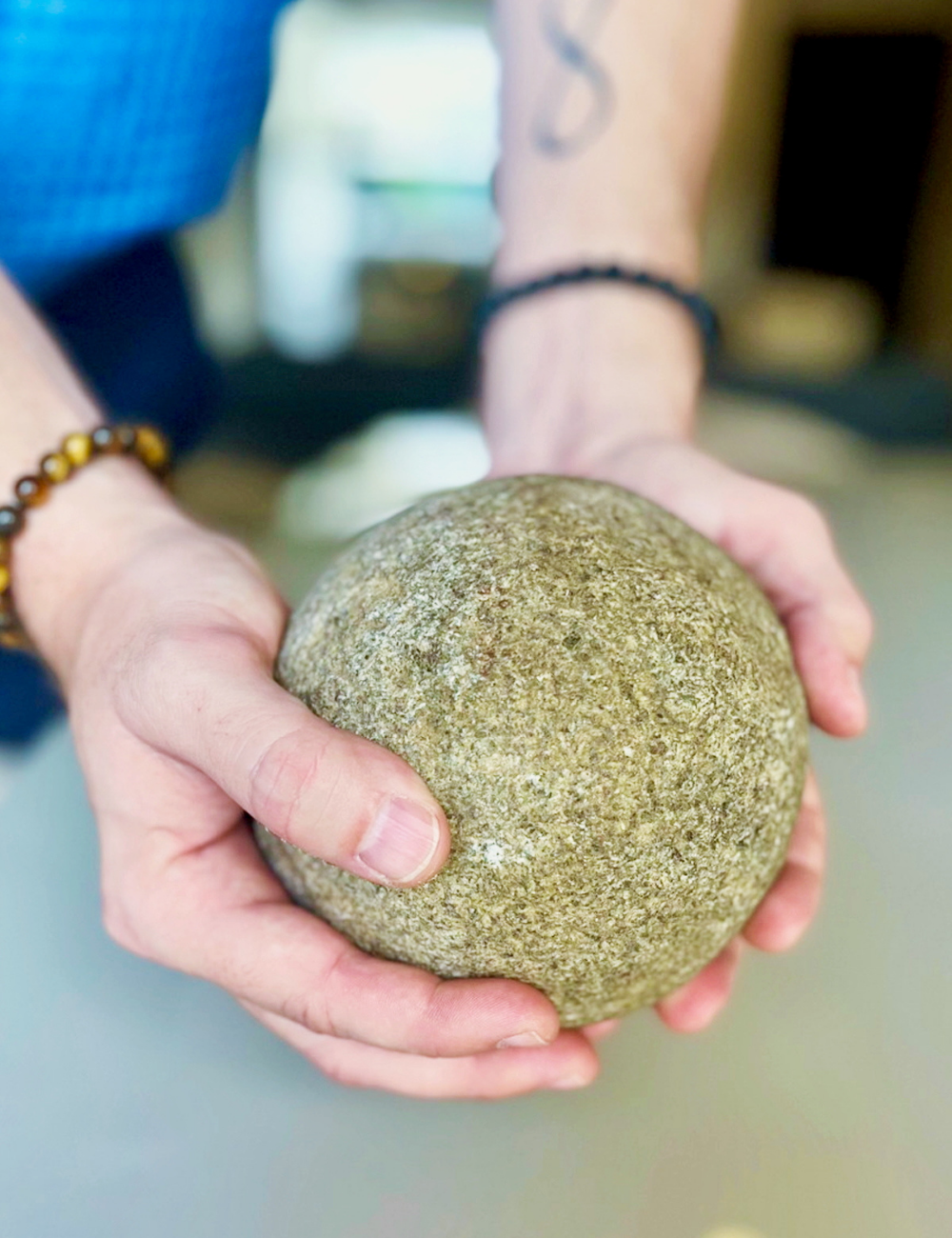
Most of the spheres are carved from granodiorite, though some are made of gabbro or limestone, rocks that do not occur in the delta. The stone had to come from the mountains, many kilometers away.
Imagine the journey: a team pries a boulder from a slope, slides it onto wooden rollers, ferries it across a river, and drags it through a tangle of vines. At a work site, someone begins the long process of shaping. Hammerstones chip away the rough edges. Heat and water open small fractures. Sand and elbow grease smooth the surface. The jungle hums. The circle slowly appears.
Clues in the Ground
The people who made the spheres lived here between 400 and 1500 CE. They did not leave written records, so archaeologists have tried to piece together their history. Excavations show stones once stood in plazas or near the raised foundations of ancient homes. Some were grouped, others lined up like markers along a path.
A few that still rest in their original placement align with the sunrise and sunset on the equinox. This has led some researchers to wonder if the stones helped track the sky. Others think they may have marked the power of a chief or the edges of a community. No single answer fits every site.
The area holds stories as well as stones. In the oral traditions of the Bribrí people, the spheres are said to be the work of Tara, the god of thunder. Legend says he fired the spheres from a giant blowgun to chase away the spirits of the winds and hurricanes. When storm season sweeps in from the Pacific, people still share this tale, linking the objects to the forces of nature.
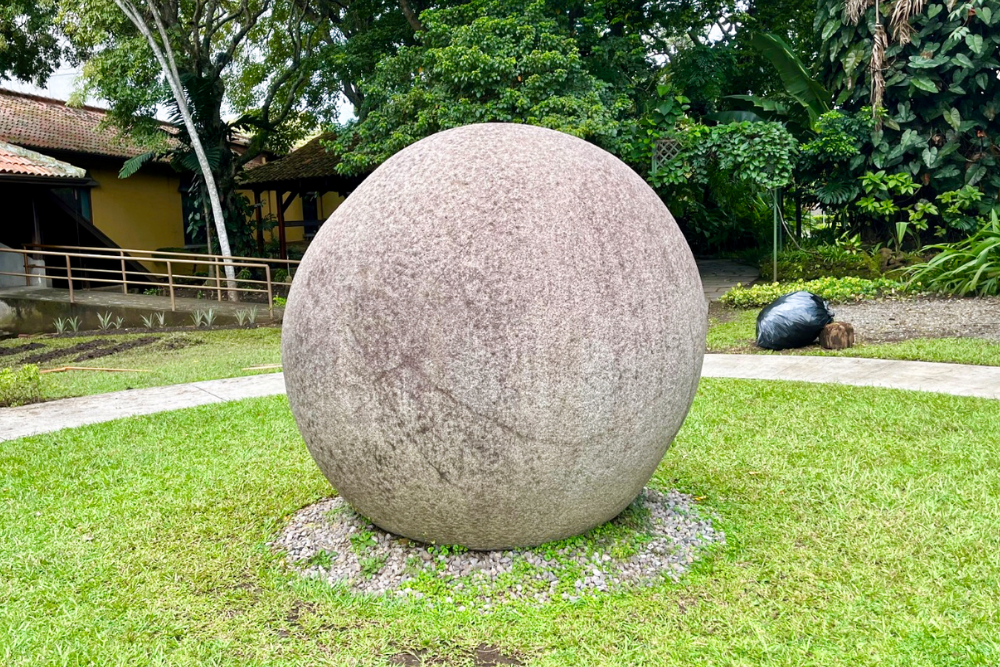
One of the stone spheres is now displayed at the National Museum of Costa Rica. Photo courtesy of the authors.
Lost and Found
Many of the spheres were moved in the years after their discovery. Some ended up in city parks, government courtyards, and private gardens. With the stones scattered, patterns that might have once been clear are harder to see.
At Finca 6, an archaeological site in the Diquís Delta whose name means “Farm 6,” several spheres remain where they were originally placed. Visitors walk along raised boardwalks through the morning mist and see the stones resting in the grass. Birds call from nearby canals. The surfaces of the spheres show rain streaks and marks from tools. Standing close, it’s easy to sense the care and effort that went into shaping them.
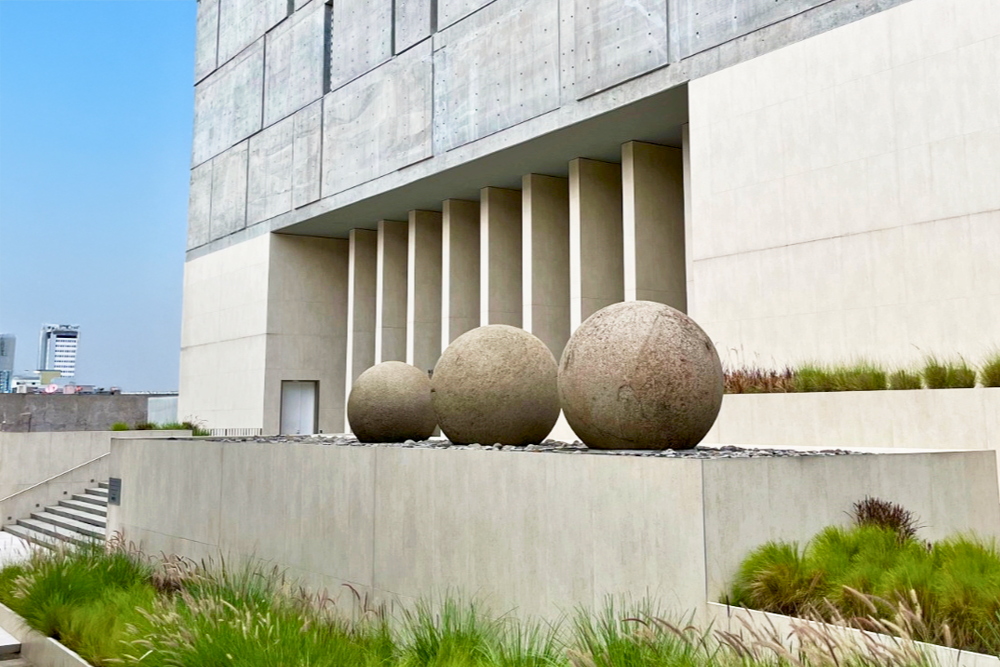
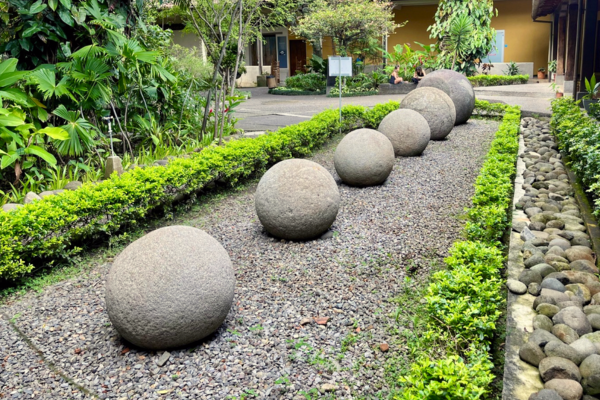
These stone spheres stand outside Costa Rica’s Legislative Assembly. Photo courtesy of the authors.
A Site to See
In 2014, UNESCO recognized the Precolumbian Chiefdom Settlements with Stone Spheres of the Diquís as a World Heritage Site. The designation protects the spheres and the surrounding landscape and highlights their importance to understanding the region’s pre-Columbian cultures.
Stand near one of the larger spheres and set your palm against it. The rock is cool even in afternoon heat. The curve beneath your hand does not change.
Long ago, skilled artisans shaped this form with simple tools and remarkable precision. In a land once hidden by jungle, that steady circle remains.
Have a suggestion for this story? We’d love for you to submit it!
Blank
Blank
Math Resources
Sample Problems:
- Archaeologists planned a sphere to be exactly 1.00 m in diameter. The finished sphere averages 0.97 m. By what percentage is the diameter smaller than planned?
- Workers can roll a sphere 1.2 kilometers per day across the lowlands. Make a table showing the cumulative distance after each day for 10 days. On which day do they first pass 7 kilometers?
- During week 1, artisans polish 40 percent of a sphere’s surface. In week 2, they polish 35 percent of the original surface (not 35 percent of what’s left). What percent of the surface remains unfinished after two weeks?
- In one cluster, two-fifths of the spheres were removed decades ago. Today 18 spheres remain in place at that location.
- How many spheres were originally there?
- What percent were removed?
- On a site map with scale 1 cm : 2.5 m, two spheres are 18 m apart in the field.
- How far apart should they be on the map?
- If the map page is 21 cm wide, could both spheres and the space between them fit on one line across the page? Explain.
- Three nearby spheres have diameters of 96 cm, 110 cm, and 126 cm.
- What is the range of these diameters?
- Compared to the smallest, by what percent is the largest larger (to the nearest tenth of a percent)?
Social Justice Questions
- The Diquís people made these almost perfect spheres long before modern tools existed. Because the spheres were buried for centuries, many people didn’t learn about their skills. What does this show about how history is often based on what gets found or written down? How might our understanding of “advanced civilizations” change when we look beyond Europe and written records?
- When the spheres were discovered, many were damaged, moved, or even broken apart by people searching for gold. How should we balance curiosity and research with respect for Indigenous heritage? Who should help decide what happens to artifacts like the Diquís spheres?
Explore Further
- UNESCO World Heritage Site description
- Theories about the spheres’ origins
- Discovery, investigation, and history of the spheres
- Restoration efforts underway
Share Your Story
Write your own Global Math Story and send it to us!
 English
  Spanish
Sorry, the comment form is closed at this time.