
ITALY
Land of Cheese and Charm
By Maggie McHugh
University of Wisconsin–La Crosse and Sparta, WI, United States
Somewhere in the rolling hills of Italy, where cypress trees sway and sheep roam contentedly under the Tuscan sun, a delicious secret is being crafted, one baaa-rilliant wheel at a time. Pecorino, the beloved sheep’s milk cheese with a bite as bold as its heritage, is more than just a dairy delight. It is a centuries-old love letter from the Italian countryside.
Join me on a journey that begins with a humble pecora (that’s “sheep” in Italian!) and ends with a salty, savory slice of tradition. As the locals say, Piano piano si fa il formaggio (“Slowly, slowly, the cheese is made”). And trust me, every dreamy, creamy bite is worth the wait.
Under the Tuscan Sun: Fattoria Bistecca
Meet Lapo Salvadori and his daughter Ilaria, cheesemakers at Fattoria Bistecca, a sun-drenched farm tucked into the hills of Cortona. Lapo may have made a cameo in the 2003 film Under the Tuscan Sun, but it’s his family’s artisan cheese that’s truly star-worthy. One golden June afternoon, a small group of us had the joy of learning to make three traditional cheeses right on their farm.
Cheese #1: Raviggiolo
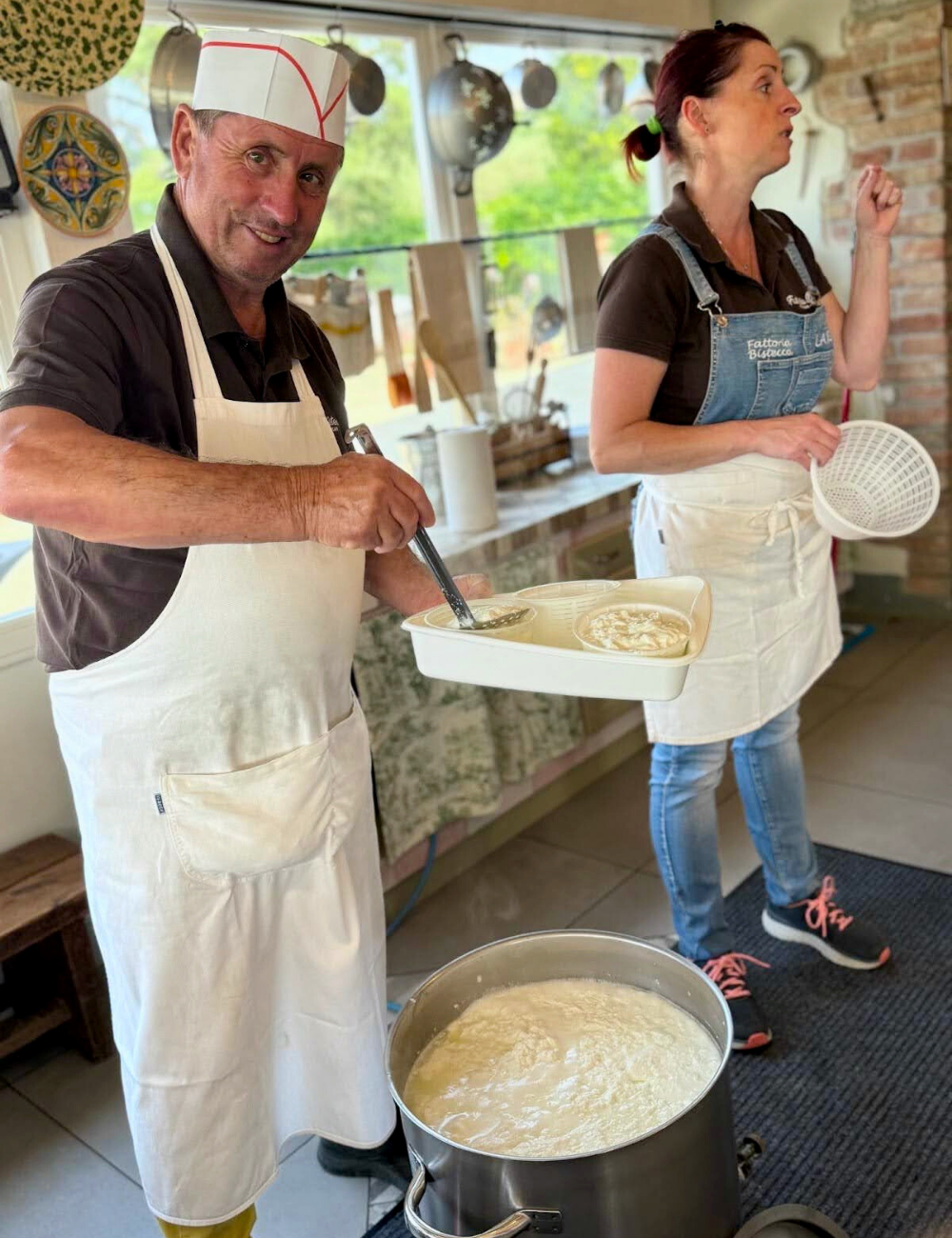
We began with a farm tour, complete with hot sun, happy sheep, and the scent of warm milk. Inside the farmhouse, Ilaria gently heated sheep’s milk to 22°C and added rennet—just 0.5 grams per 10 liters (L).
The result was raviggiolo, a silky cheese best eaten within 48 hours. Fresh from the vat, it’s a little sweet and very milky.
Ideally, it’s slathered on Tuscan bread with olive oil and cracked pepper. Yes, please!
Cheese #2: Pecorino
Next came the star of the show: pecorino, literally translated as “of sheep” in Italian. Lapo stirred the raviggiolo, breaking it down into curds. Then came the fishing: scooping warm curd from the whey with our hands, forming hefty balls of cheese dough. Gently, we pressed, pinched, salted, and flipped our way to the first stage of pecorino perfection.
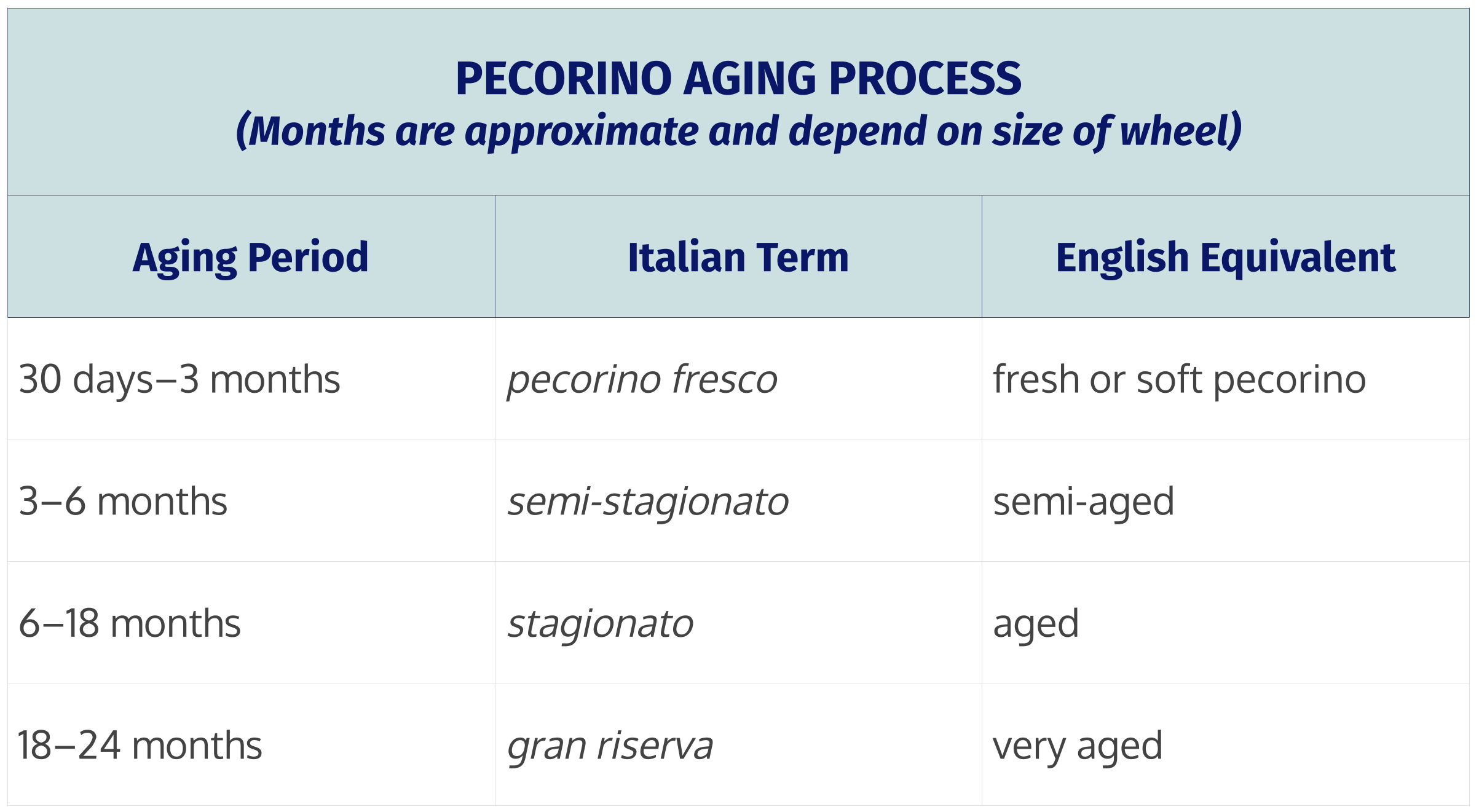
The aging process is part alchemy, part patience: four days of flipping and salting, followed by 25 more days of gentle turning to form a firm crust. At one month, it’s pecorino fresco, fresh pecorino—mild and creamy. Aged longer, it’s brushed with olive oil, sealed with tomato paste or an ashy wood mixture. After six months, it becomes pecorino stagionato, aged pecorino—a sharp, robust cheese that is low in lactose.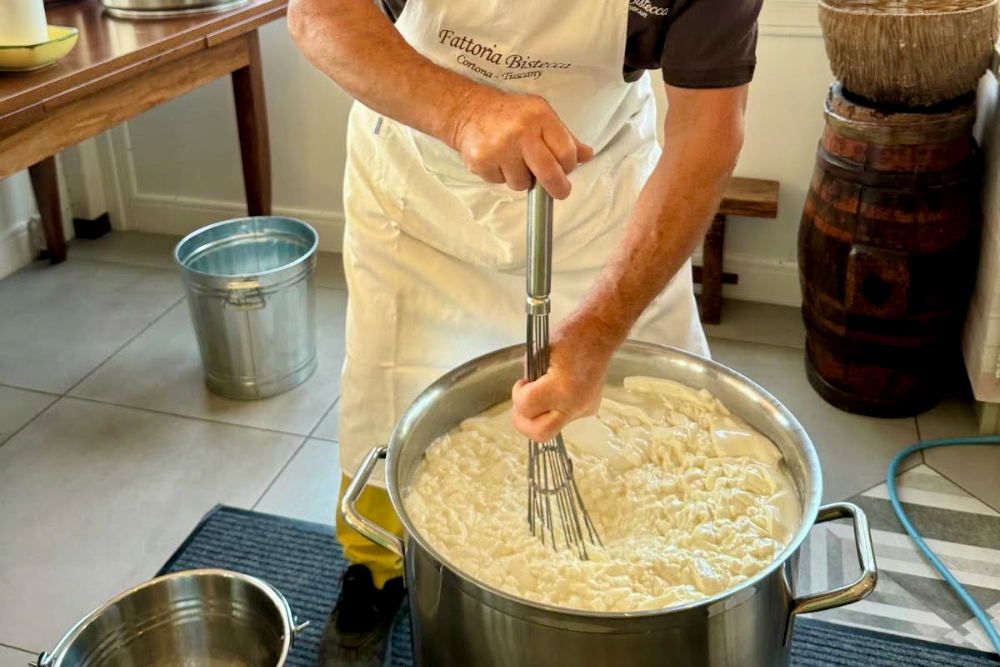
Lapo stirs the raviggiolo, starting the process to make pecorino. Photo courtesy of the author.
Cheese #3: Ricotta
We nearly forgot the leftover whey! Reheated, skimmed, and drained, it became ricotta, literally “re-cooked.” While raviggiolo and pecorino are strictly sheep’s milk, ricotta plays the field: sheep, cow, goat, you name it. Sweet or savory, it’s the workhorse of Italian kitchens.
Arrivederci, Pecorino!
As the sun dipped low, we nibbled pecorino and sheep’s-milk desserts, full and happy. Ilaria’s final surprise? If our cheese passed muster, we’d get an email in three months with shipping instructions.
I wait for it still. Not goodbye, but arrivederci (“Until we meet again”). Because when it comes to cheese this good, parting is only temporary.

Lapo gives Maggie some cheese dough to begin the pecorino making process. Photo courtesy of the author.
Field Notes
- In prime milking conditions, sheep on an organic farm produce about 2 L of milk per day. On a non-organic farm where the goal is only to produce milk, sheep may produce up to 5 L of milk per day.
- Sheep’s milk must be heated to about 22°C to form curd.
- The enzyme rennet acts in about 20–25 minutes.
- It takes about 4 L of sheep’s milk to produce a ball of cheese dough for a wheel of pecorino measuring 15 centimeters in diameter and 8 centimeters in height.
- Five liters of whey produce about 500 g of ricotta.
Have a suggestion for this story? We’d love for you to submit it!

Blank
Blank
Math Resources
Sample Problems:
- Grade 1: Ilaria filled three cheese baskets. Each basket holds two balls of cheese. How many cheese balls did she make?
- Grade 2: Ilaria weighs her pecorino cheese wheels. Her tomato paste wheel weighs 718 g. Her ashy wheel weighs 687 g. Which wheel weighs more? By how much?
- Grade 3: One sheep gives 2 L of milk a day. How much milk will six sheep give in three days?
- Grade 4
- Each wheel of cheese is 15 centimeters wide. If Ilaria places four wheels side by side on a shelf, how wide is the row?
- Bonus: Each guest needs three slices of bread and five slices of cheese for a snack. If 12 guests are coming, how many slices of bread and cheese will they need?
- Grade 5: It takes 4 L of milk to make a cheese wheel. If the farm collected 60 L of milk, how many cheese wheels can they make? Will there be any milk left over?
- Grade 6
- To make ricotta, Ilaria needs 5 L of whey to get 500 g of cheese. If she collects 40 L of whey, how many grams of ricotta can she make?
- Bonus: It takes 0.5 g of rennet for every 10 L of milk. If the farm uses 45 L of milk, how many grams of rennet will they need?
- Grade 7
- A wheel of pecorino cheese has a diameter of 15 centimeters and a height of 8 centimeters. What is the volume of the wheel? (Use π ≈ 3.14).
- Bonus: Fresh pecorino is aged for 30 to 90 days. If a wheel is flipped every day for the first four days, then every third day after that, how many times is it flipped in 60 days?
- Grade 8: The cost of producing one aged cheese wheel is €6.50 per liter of milk. If each wheel uses x liters of milk, write an equation and draw a graph to show the cost of producing one cheese wheel. Illaria does not like to use more than 10.5 L of milk. How much would the cost be to produce that cheese wheel? How do you know?
- High School: The cost of producing one aged cheese wheel is €6.50 per liter of milk. If each wheel uses x liters of milk and sells for €48, what is the profit per wheel? How many whole liters of milk could be used to still turn a profit? How do you know?
Social Justice Questions
- Cheese making at Fattoria Bistecca takes time, care, and traditional knowledge passed down through generations. Yet larger factories can produce cheese faster and cheaper. If you were a local leader in Cortona, how would you support small cheese makers while also making sure food is affordable for everyone?
- Tourists visit farms like Fattoria Bistecca to learn traditional cheese-making, but as tourism grows, it can change the pace and purpose of daily life. How can communities welcome visitors without losing what makes their way of life special?
- Some pecorino is aged for over a year and sold at a much higher price, but it takes a lot more time, space, and attention. If you were running a small farm, would you focus on selling more fresh cheese quickly or aging fewer wheels for greater profit? What factors would affect your decision?
Explore Further
- Website of Fattoria Bistecca
- History of pecorino cheese
- Different varieties of pecorino cheese
- How to make pecorino cheese
Share Your Story
Write your own Global Math Story and send it to us!
 English
  Spanish
Sorry, the comment form is closed at this time.