
BANGLADESH
The Floating Schoolhouse
By Chadd McGlone
Chapel Hill, NC, United States
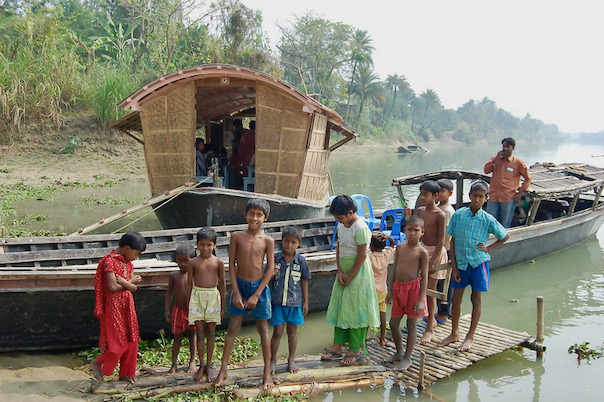
Can you imagine going to school on a boat? What would you think if instead of driving to school, a floating classroom came to your house every day? This is how it happens in northwest Bangladesh for hundreds of students.
Shidhulai Swanirvar Sangstha is one of the nonprofit organizations that runs these floating schools in the Chalanbeel region. Flooding is a big problem in this wetland area, preventing children from getting to school. If the students can’t come to class, then class will come to the students!
Water Worries
During the monsoon season, which typically runs from June to September, about one-quarter of Bangladesh can be affected by flooding. In 2024, severe floods displaced more than 5.8 million people and damaged over 80,000 homes across the country. Because nearly 70 percent of Bangladesh’s land lies less than one meter above sea level, even moderate rises in river levels can inundate roads and farmland.
Flooding disrupts education, too. When schools are closed or roads are underwater, thousands of students are unable to attend classes for weeks. In flood-prone areas, these repeated disruptions can increase the risk of school dropout, especially for students who already face barriers to education.
Bangladesh is considered one of the most climate-vulnerable countries in the world. According to the World Bank, sea levels in the Bay of Bengal could rise between 0.3 and 1 meter by the end of the century. In response, communities, scientists, and government leaders are working together to protect future generations from the growing impacts of climate change.
A Boat Can Be a Schoolhouse
The boats that function as floating schools are approximately 15 meters long and 3 meters across. On average these can accommodate 30 students and their teacher. The boats are built using local traditional design. Nontraditional elements have also been included, such as solar panels to power computers on the boats. This eco-friendly idea is one of the reasons why floating schools have been a great success.
On a typical day, a student sits outside her house on the river waiting for her school to arrive. Once onboard the boat, classes are held in a variety of important subjects. Students may learn to identify local species of birds and fish and even make their own floating gardens.
And So Much More
These boats are not just for kids! The founders of the organization have tried to reach the general population by outfitting boats to offer other services:
- seminars on women’s health, nutrition, hygiene, and sustainable farming
- libraries
- health clinics
Rivers don’t have to be barriers. Riding waves of opportunity, they can be the future.
Have a suggestion for this story? We’d love for you to submit it!

Blank
Blank
Presentations
Are you a teacher who’s interested in telling this story to your students? Here are slideshows to get you started.
- Overview (in Spanish)
- Common Core 2.OA (in English)
Math Resources
Learning Activities:
- Multiplication (Grades 4–5)
- Connecting to the Standards: The Number System (Grade 6)
Sample Problems:
- What is the area of the boat, given the dimensions mentioned in the story?
- Imagine you are a teacher of a floating school. You need to teach five subjects each day. You also need to give your students a break to stretch their legs every 45 minutes. Design your school day’s schedule.
- Graph what the rise in water level looks like if it increases four inches per year. Repeat this in centimeters. In 100 years, how much will the river have risen? Does your answer make sense?
Social Justice Question
Given the effect of climate change, what responsibility do you believe countries with high carbon dioxide emissions should have in supporting these floating schoolhouses financially?
Explore Further
- Website of Shidhulai Swanirvar Sangstha
- New York Times article
- National Public Radio story
- Video of solar-powered boats
Share Your Story
Write your own Global Math Story and send it to us!
 English
  Spanish
Sorry, the comment form is closed at this time.