
BRAZIL
The Art of the Shortcut
By Arthur Powell
Montclair, NJ, United States
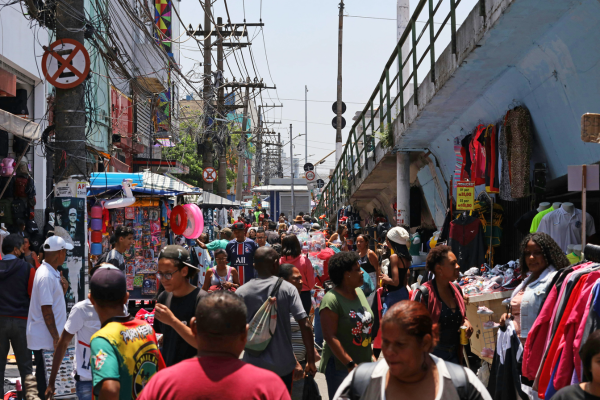
In southeastern Brazil, the city of São Paulo is home to nearly 12 million people spread across more than 1,500 square kilometers (about 580 square miles). Its main avenues can stretch six lanes wide, and its bus system carries millions of passengers each day. This density means that a trip that covers 15 kilometers (9.32 miles) on a map may take an hour and a half by car, and even longer when rain floods some streets.
Between the main roads, narrow passages called becos cut through the blocks. In Portuguese, the word beco means a narrow alley or passage. Some are paved; some are dirt or gravel. A wider beco might measure about three meters (m) across, while a narrow one might have just enough room for two people to pass each other on foot.
Some becos slip behind shops, bend around corners, or descend short sets of steps. From the street, a beco’s entrance may look easy to miss. For someone who knows where it leads, it can be the quickest way through the neighborhood.
Shorter on the Map
A beco can save time because it changes the shape of a route. Instead of walking around a long block, crossing a busy avenue, or climbing a hill, a person may be able to take a shortcut. A student on the way to school, a worker carrying lunch, or a neighbor with groceries may save several minutes by avoiding the main road.
But a shortcut is not automatically faster. While the distance may look shorter on a map, covering it may take more time. A table set near a wall may leave little walking space. A food stand may draw a small group, crowding out the available passing space. After a rainstorm, water may collect in uneven patches of pavement. If five people stop in a narrow section, others may have to wait, turn sideways, or weave through one at a time.
Finding the way can also slow a person down. From the entrance, a beco may look like a straight passage, but farther in, it might bend, narrow, or split into two smaller paths. Someone unfamiliar with the route may not know which direction leads out and which leads deeper between the buildings.
That is why local knowledge matters. People who use the same becos often know where the pavement breaks, where puddles form, where the path narrows, and which entrance leads toward the bus stop, the school, or the bakery. Where a visitor may see a maze, a resident sees a familiar path that becomes an almost intuitive shortcut.

Photo “Beco do Batman” by Nicolas de Camaret. Licensed under CC BY 2.0.
Painted Landmarks
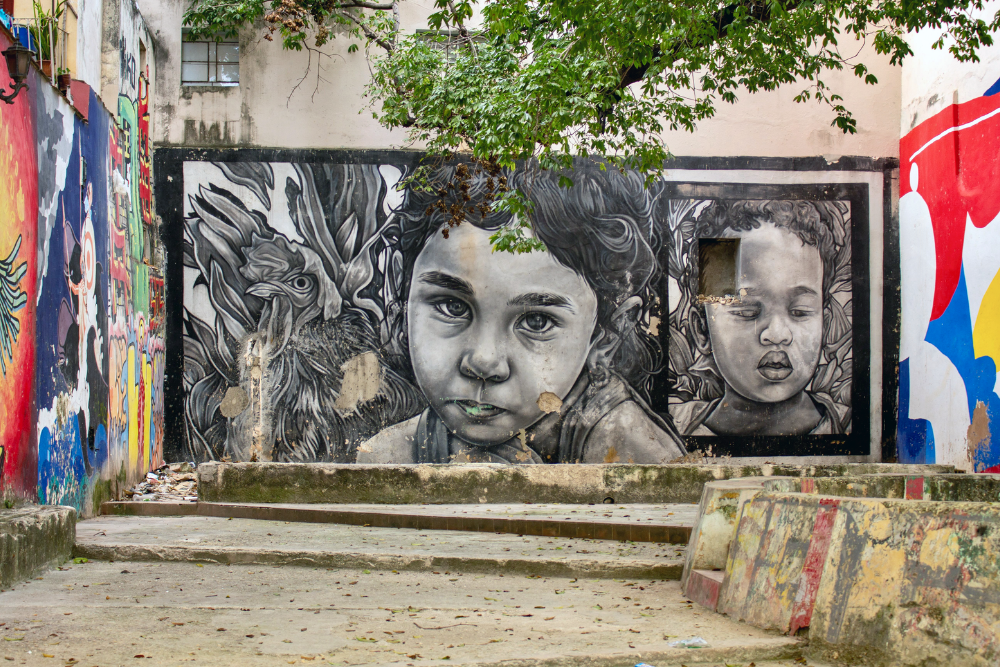
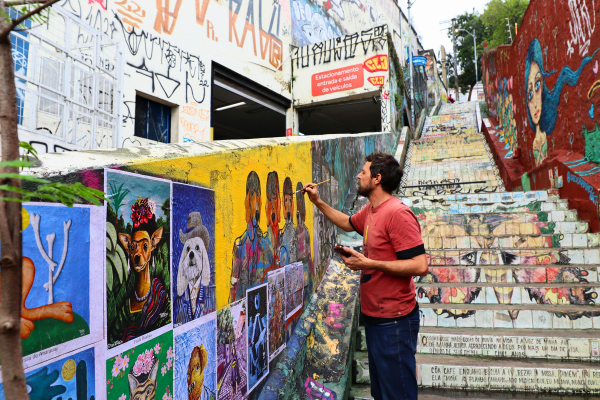
Many of São Paulo’s becos are also covered with paint. Murals, tags, faces, birds, phrases, and whole scenes stretch across concrete walls. In the Vila Madalena neighborhood, Beco do Batman, or Batman Alley, has become one of the city’s best-known examples. The passage became famous after a drawing of Batman appeared on one of its walls in the 1980s. That original drawing is gone, but the name stayed. Today, the short route is covered with murals and graffiti, and visitors often stop to take photos along the way. This beco is as much a destination as a shortcut.
In painted becos, the artwork can become landmarks—part of how people understand and remember the route. Instead of street signs, people may use the details they know: turn left after the graffiti, pass the food stand, keep going until the path opens near the road.
But those same paintings can also change the timing of a walk. People may stop to look, take pictures, or watch an artist at work. When several people gather near a mural, the usable width of the passage shrinks. A route that is short on the map may take longer when the narrow space fills with people.
Finding the Fastest Way
A beco, then, is given character by the people who walk it and by the artists who cover it with color. Knowing a beco well means remembering where the pavement dips, which mural marks the turn, where shoulders must angle through the narrow stretch, and which passages are likely to be clogged at what time of day. The daily act of choosing shortcuts builds knowledge while it saves time.
São Paulo’s becos remind us that a city’s geography lives in the cuts between buildings, the paint on the walls, and the step-by-step knowledge of people who have learned how to find their way quickly.
Have a suggestion for this story? We’d love for you to submit it!
Blank
Blank
Math Resources
Sample Problems:
- A beco is 80 m long. A student walks 40 m in the first minute and 40 m in the second minute. How many minutes does it take the student to walk through the beco?
- Walking around the block takes 12 minutes. Taking the beco takes five minutes. How many minutes does the beco save? If someone takes this shortcut twice a day, how many minutes do they save in one day?
- A worker saves six minutes each morning by taking a beco instead of the main road. How many minutes does the worker save in five mornings? How many hours is that?
- A narrow beco is 1.5 m wide. A table takes up half of that width. How much walking space is left? Do you think two people could pass each other comfortably in that space? Explain your thinking.
- A mural covers a wall that is 3 m tall and 6 m wide. What is the area of the mural? If a new painting covers half of the mural, how many square meters are still visible?
- Two routes lead to the same place in São Paulo. The main road is 600 m long and takes eight minutes to walk. The beco route is only 300 m long, but it takes 10 minutes to walk. Which route is shorter in distance? Which route is faster in time? Why might the shorter route take longer? Now calculate the walking speed for each route in meters per minute.
Social Justice Question
A beco can be a shortcut for residents and a destination for visitors. When more people gather in a narrow passage, the way they use it can change. How can communities balance the needs of people who depend on a space for daily movement with the interests of people who come to enjoy its art?
Explore Further
- History of São Paulo
- Information about the artistic creativity thriving in São Paulo
- Painted murals in and around Batman Alley
- Real-time walk-through of Batman Alley
Share Your Story
Write your own Global Math Story and send it to us!
 English
  Spanish
Sorry, the comment form is closed at this time.