
MEXICO
The Secret of the Forts
By Keila Barreda
Puebla, Mexico
Have you ever visited a place where history changed forever? What if you could stand in the exact spot where brave people protected their country?
High above the city of Puebla, Mexico, two stone forts sit quietly on top of a hill once known as Acueyametepec. At first glance, they may look like ordinary old buildings. But they have an incredible story to tell.
From Chapels to Forts
Long before it hosted military forts, the hill held places of worship. The chapel that became Fort Loreto was built during the 1600s. The site of Fort Guadalupe had several religious buildings over the centuries, including a church dedicated to the Virgin of Guadalupe.
During the early 1800s, the buildings were strengthened and adapted for military use. Their position above Puebla allowed soldiers to watch the roads and surrounding countryside. No one knew that the forts would soon become the setting for one of the most famous battles in Mexican history.
A Day of Courage
On May 5, 1862, thousands of French soldiers marched toward Puebla. At that time, the French army was considered one of the strongest armies in the world.
The Mexican army, led by General Ignacio Zaragoza, was smaller and had fewer resources. Even so, the soldiers refused to give up. They defended the forts of Loreto and Guadalupe with determination, courage, and teamwork.
After hours of fighting, something incredible happened. The French army retreated, and Mexico celebrated an unexpected victory. Today, people around the world remember this historic event every year on Cinco de Mayo.
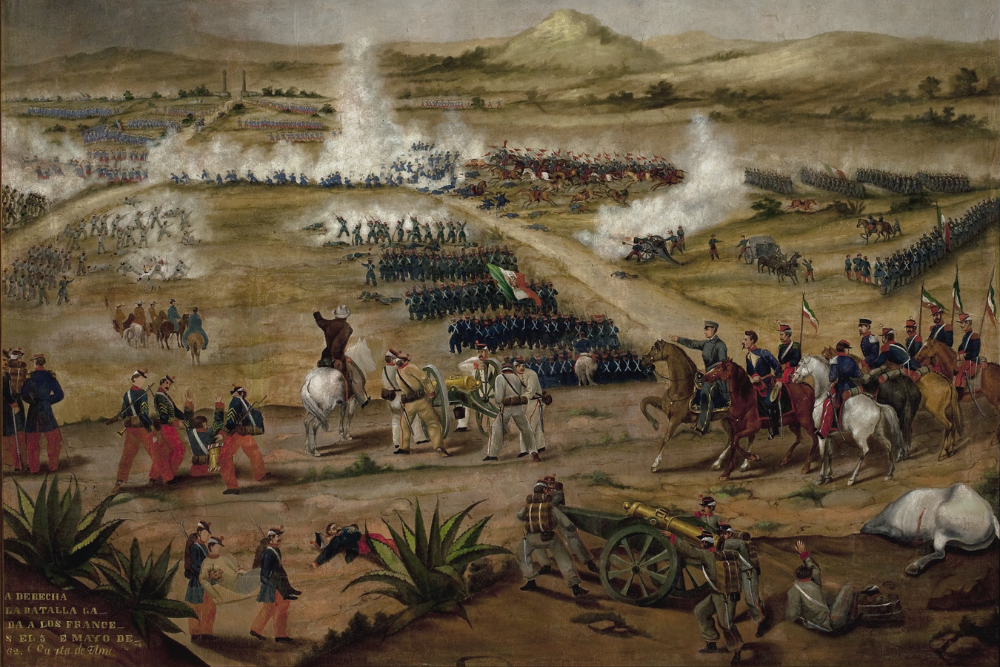
Adaptation of photo “Batalla del 5 de mayo de 1862” via Mediateca INAH at the Museo Nacional de las Intervenciones. Painting by an unknown artist. Public domain.
Treasures of the Past
Today, the battle is long over, but the forts still protect something very special: memories of history. Inside the museums, visitors can discover real objects from the 1800s, including military uniforms, weapons, flags, paintings, important documents, and items from everyday life.
One of the most fascinating exhibits includes letters written by President Benito Juárez to General Ignacio Zaragoza, along with portraits of the heroes who defended the city. Interactive displays allow visitors to experience the story of the Battle of Puebla in exciting new ways.
Two Different Forts
Although the forts of Loreto and Guadalupe formed part of the same defensive line, they are not exactly the same. The two are about 928 meters (m; 3,045 feet) apart. Loreto has large round sections called bastions, while Guadalupe has two smaller bastions that protected its entrance. Their design helped soldiers watch over the surrounding hills and prepare for danger.
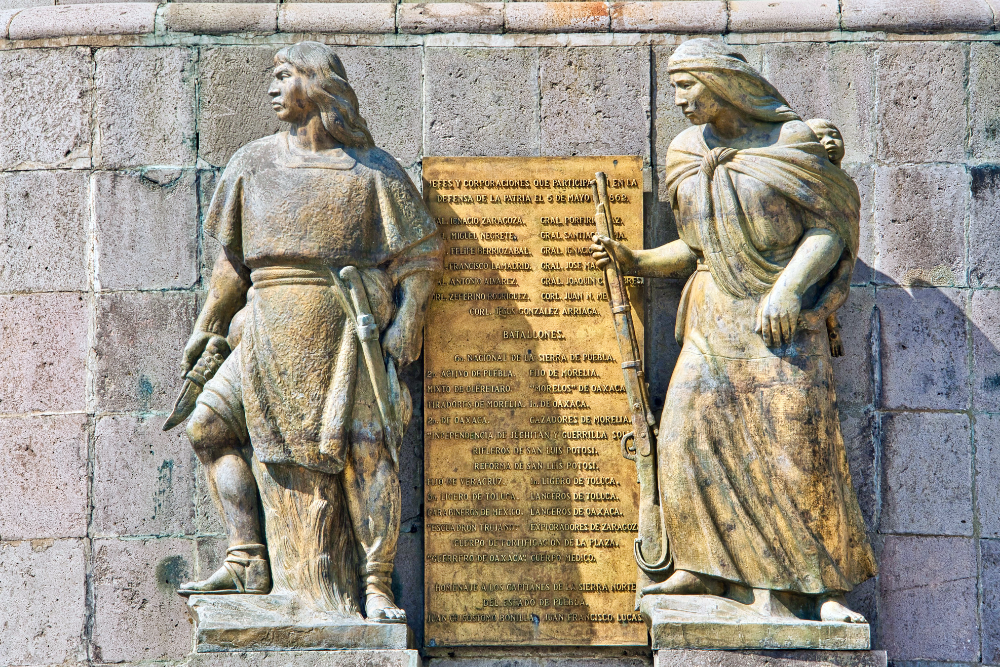
Adaptation of “Monumento a ‘La Victoria’ del 5 de Mayo” by Ted McGrath. Licensed under CC BY-NC-SA 2.0.
A Place Full of History
Today, the Historic Zone of the Forts is one of Puebla’s most popular places to visit. Families walk through beautiful gardens, students explore the museums, and tourists from around the world come to learn about the famous battle.
Visitors can also enjoy scenic viewpoints, peaceful walking paths, and spectacular views of the city below. The cannons may no longer fire, and the soldiers are gone, but the forts of Loreto and Guadalupe continue to tell a story of courage, hope, and determination.
Who knows? Maybe the next time you visit, you’ll discover a story waiting just for you.
Have a suggestion for this story? We’d love for you to submit it!
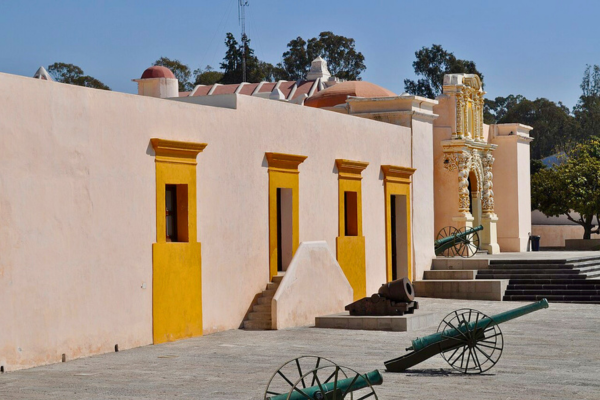
Adaptation of “Antiguo Fuerte de Loreto” by Lsalgador82. Licensed under CC BY-SA 3.0.

Adaptation of “Fuerte De Loreto, Puebla” by Comisión Mexicana de Filmaciones. Licensed under CC BY-SA 2.0.
Blank
Blank
Math Resources
Sample Problems:
- Kindergarten: The two forts have different shapes. Use blocks or drawings to design two forts that look different from each other. What shapes did you use, and how can you tell the forts are different?
- Grade 1: A walking path begins at the bottom of the hill and ends near the forts. Put these parts of the walk in order from shortest to longest: 8 steps, 15 steps, 11 steps, and 6 steps. Explain how you decided.
- Grade 2: A museum display has four rows with six objects in each row. Draw an array to represent the display. Write an addition equation and a multiplication equation that match your array.
- Grade 3: A walking tour lasts 90 minutes. The group spends one-third of the time inside a museum and one-sixth of the time at a viewpoint. How many minutes remain for walking between locations?
- Grade 4: Fort Loreto and Fort Guadalupe are about 928 m apart. A student says this is closer to 900 m than to 1,000 m. Is the student correct? Use a number line and explain your reasoning.
- Grade 5: A model of one fort uses a scale of 1 centimeter for every 20 meters. A wall that is 140 m long in real life is represented in the model. How long should the wall be in the model? Explain your reasoning.
- Grade 6: The two forts are approximately 928 m apart. On a map, the distance between them is 5.8 centimeters. What scale does the map use, expressed as centimeters to meters? Explain how you know.
- Grade 7: A tour company charges a fixed reservation fee plus 65 pesos per visitor. A group of 18 visitors pays 1,320 pesos. Write and solve an equation to determine the reservation fee. Explain what each part of the equation represents.
- Grade 8: Place Fort Loreto at (1, 2) and Fort Guadalupe at (9, 8) on a coordinate plane. Find the midpoint between the forts. Explain what the midpoint could represent in planning a rest area or information station.
- Grades 9–12: City planners want to place a shuttle stop so that it is equally distant from Fort Loreto, Fort Guadalupe, and a museum entrance. Represent the three locations on a coordinate plane and develop a method for finding the point that is equidistant from all three. Explain when such a location would be practical and when minimizing total travel distance might be a better goal.
Social Justice Questions
- After a battle, some leaders and soldiers become famous while others are rarely mentioned. Why do some people come to be remembered as heroes, and whose contributions might be overlooked? Why is it important to seek out the stories of ordinary people as well as well-known figures?
- Museums preserve objects, documents, and personal stories from the past. How can they help visitors understand both the courage shown during a battle and the harm caused by war? What should museums include that would give a complete, honest picture?
Explore Further
- Websites of the Fort Loreto and Fort Guadalupe museums
- Collection of letters about the Battle of Puebla
- Historic photographs of Puebla
- Video about the origin of Cinco de Mayo
Share Your Story
Write your own Global Math Story and send it to us!
 English
  Spanish
Sorry, the comment form is closed at this time.