
NAMIBIA
Penguins, Please
By Rhonda Marquardt
Everett, WA, United States
Let’s start with an experiment. What animal pops into your mind when you think of Africa? Probably you pictured a lion, zebra, elephant or giraffe. Maybe you visualized a leopard or hippopotamus. How many prompts would it take for you to picture a penguin?
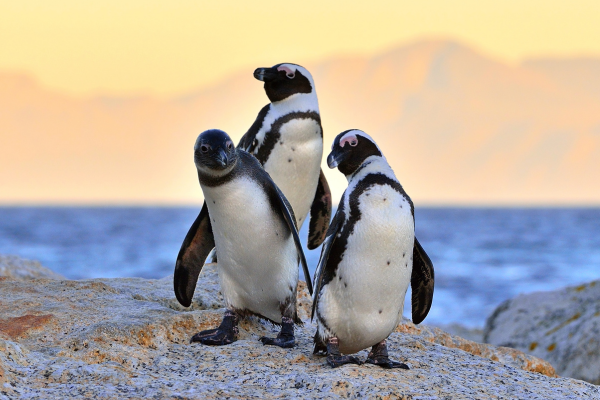
Most people associate penguins with cold climates, but not all of them live in places covered with snow and ice. Penguins living in Africa occupy more than 24 islands and rocks scattered along 220 miles (355 kilometers) of the coast of Namibia.
Guess what those islands are called? Yep, the Penguin Islands.
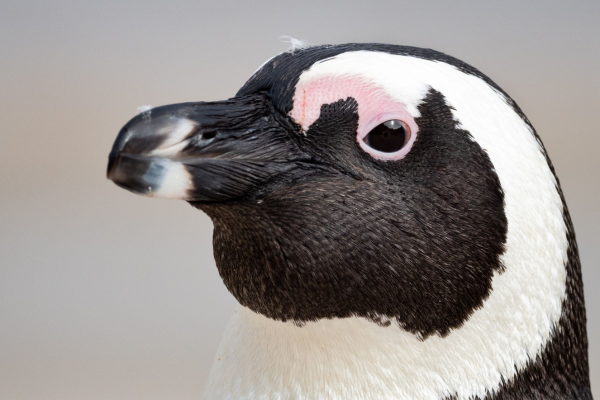
The African penguin is a charismatic species that is known for its loud, donkey-like braying noises, distinctive black-and-white plumage, and large breeding colonies. It is a flightless bird that is well adapted to life at sea. Its body is streamlined with modified wings that resemble flippers, which enable efficient swimming. A thick layer of overlapping feathers assists with waterproofing and insulation.
Fun Facts
Here are some interesting facts about African penguins:
- Pink patches of skin above each of their eyes become more colorful when they’re hot.
- They may eat a pound of fish and other prey each day.
- While they molt (replace their feathers), they don’t eat for three weeks.
- Both parents take turns keeping their eggs safe until the chicks hatch.
- They often nest by digging into piles of seabird droppings.
The African penguin has experienced rapid population declines over the past century as a result of collecting its eggs for food, habitat modification of nesting sites, oil spills, and competition for resources with commercial fishing.
Scientists estimate that as many as four million penguins may have lived along the southern African coast at the beginning of the 1800s. The current count is fewer than 20,000 mature individuals. As a result, the African penguin is considered critically endangered.
Have a suggestion for this story? We’d love for you to submit it!
Blank
Blank
Math Resources
Learning Activity:
- Algebra 1 (Middle School)
Sample Problems:
- While sightseeing you count 21 penguins. Eight of them are sitting on a nest and the rest are near the water. How many are near the water?
- Every day a tourism company runs six tours of beaches popular with penguins. Today’s trips have exactly eight people on each one. How many people will go on tours today?
- The maximum number of people who can be at a particular beach at the same time is 23. If one group has nine people in it and the second group has seven, how many people can be in the third group?
- A group of penguins is called a waddle. One waddle has 23 penguins in it. If there are 17 adults, how many chicks are in this waddle?
- You decide to take a boat tour to see penguins swimming in the ocean. At one time, you count 7 penguins to the right of the boat, 6 to the left of the boat, and 13 behind it. How many penguins do you see in total?
- There are 27 penguins in a waddle. If, on average, each penguin eats between two and three pounds of food each day, how much food will this waddle eat?
- Dayja is coordinating a school field trip to the Penguin Islands. Currently there are 6 people in the first group, 8 in the second group, and 11 in the third group. She has 17 more people to place in a group. If Dayja divides the remaining people so that there is the same number of people in each group, how many people will be in each group when she is done?
- After a trip to the Penguin Islands, Jorge, Nathan, and Samuel are inspired to carve penguins out of wood and sell them as a fundraiser. Jorge carves two penguins, Nathan carves four penguins, and Samuel carves one penguin. By the end of the event, the three boys raised US$28 to support conservation on the islands. On average, how much did each wood carving cost?
Extension Question
Approximately 3,000 African penguins live on a protected beach near Cape Town, South Africa. Called Boulders Beach, the entire area is open to tourists. In fact, there are no fences or enclosures to separate the penguins from their human visitors. Because this species of penguin is endangered, do you think more should be done to keep them safe from harm? Or do the benefits of allowing up-close encounters outweigh any possible risks to the birds?
Explore Further
- Website of the South African Foundation for the Conservation of Coastal Birds
- International Union for the Conservation of Nature Red List of Threatened Species
- San Diego Zoo’s live penguin cam
- Video of African penguins at Boulders Beach
Share Your Story
Write your own Global Math Story and send it to us!
 English
  Spanish
Sorry, the comment form is closed at this time.