
RUSSIA
A Crater Full of Diamonds
By Jenny McGlone
Chapel Hill, NC, United States
If you could close your eyes and imagine the largest number possible of some small item, would it be one of these?
- A mountain of pebbles?
- A football stadium full of pennies?
- An ocean of paper clips?
What if that huge amount of something were diamonds? And if the value of that pile of diamonds was a number in the billions, then you would probably be pretty amazed, right?
Buried Treasure
In one of the coldest and most remote parts of Russia lies a reserve of diamonds that could contain trillions of carats. Located in northern Siberia in the Popigai Crater, some reports have claimed that the supply could be large enough to meet the world’s needs for thousands of years.
These are not the sparkling gems you would expect to see in jewelry. Most are tiny, low-purity impact stones, better suited for scientific and industrial uses than for engagement rings.
Asteroid Crash
Geologists believe this bonanza of diamonds formed about 35.7 million years ago when an asteroid crashed into Earth. The visitor from outer space was somewhere between three and five miles in diameter, and its collision created a crater about 62 miles (100 kilometers) across.
When it struck graphite-bearing material, some of the carbon inside transformed into diamonds almost instantly. Because the stones formed under such sudden heat and pressure, many did not grow large and clear. Instead, they remained small and grainy.
Digging for Diamonds
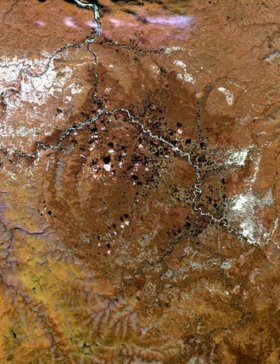
Soviet geologist D. V. Kogevin discovered the crater in 1946. At first, scientists thought it was a volcanic structure. In the early 1970s, further research showed that it was actually an impact crater and that its rocks contained unusual crystals.
For many years, information about the deposit was not widely shared. Some reports suggest that Soviet leaders may have kept quiet about it because they had already invested heavily in making synthetic industrial diamonds.
In 2012, Russian scientists drew new attention to the enormous size of the supply. Some news reports made the discovery sound like a massive treasure chest full of hidden gems.
Geologists today doubt that Popigai’s cache will flood the market any time soon. The crater is extremely remote, and industrial diamonds can now be made more cheaply in laboratories.
If you’re seeking a bargain on an engagement ring, these stones are unlikely to help you. However, if you need a super-tough diamond for a drill bit or grinding machine, Popigai may still sound like buried treasure!
Have a suggestion for this story?We’d love for you to submit it!
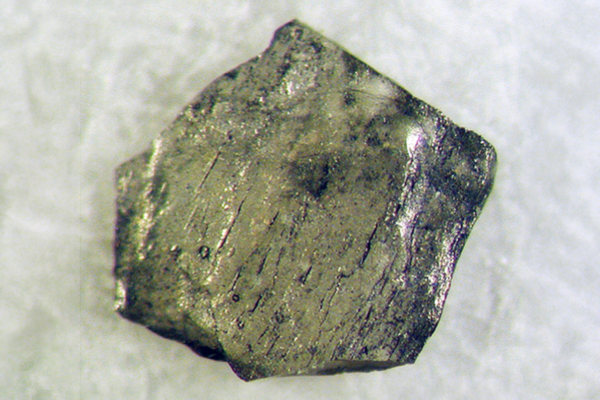
Adaptation of “Popigai Nanodiamonds” by Hiroaki Ohfuji et al. Licensed under CC BY 4.0.
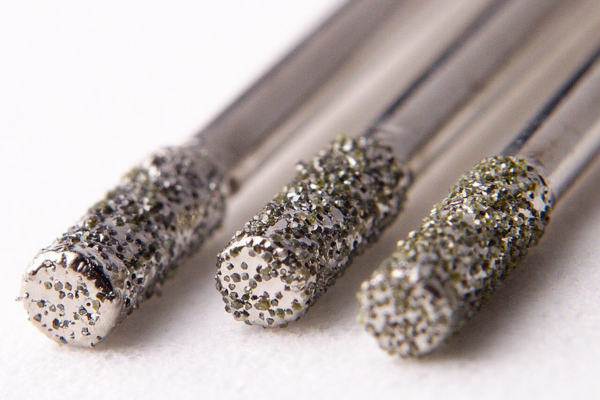
Photo “2mm Diamond Drill Bits Macro” by Junkyardsparkle. CC0 1.0 Universal.
Blank
Blank
Math Resources
Learning Activity:
Sample Problems:
- How many zeros are in one trillion? Write this number in scientific notation.
- Draw a circle that represents the crater. Now calculate how much of that circle contains diamonds. Shade that one differently. What percentage of the crater contains diamonds?
- If the crater has a diameter of 62 miles, what is the area of the circle it encompasses? What would those measurements be in kilometers?
Social Justice Question
Popigai’s stones may be useful for industry, but this type of diamond can also be made in laboratories. When people can create a resource another way, how should they decide whether to mine it from a remote or fragile landscape? Who should have a voice in that decision, and how should the benefits and risks be shared?
Explore Further
- A geologist’s opinion that the Popogai crater is overhyped
- Facts for kids about the Popogai crater
- More information about the value of the site
- Video showing industrial diamonds
- How to make impact diamonds in a laboratory
Share Your Story
Write your own Global Math Story and send it to us!
 English
  Spanish
Sorry, the comment form is closed at this time.