
SOUTH AFRICA
The Builders in the Trees
By Chadd McGlone
Chapel Hill, NC, United States
Along the rivers and wetlands of South Africa, certain trees seem to have unusual decorations. From their branches hang woven shapes that sway gently in the breeze. At first glance, they resemble clusters of gourds or lanterns. A closer look reveals something far more intricate: carefully constructed nests built by weaverbirds, small birds with bright yellow feathers and dark facial markings.
The Work of Weaving
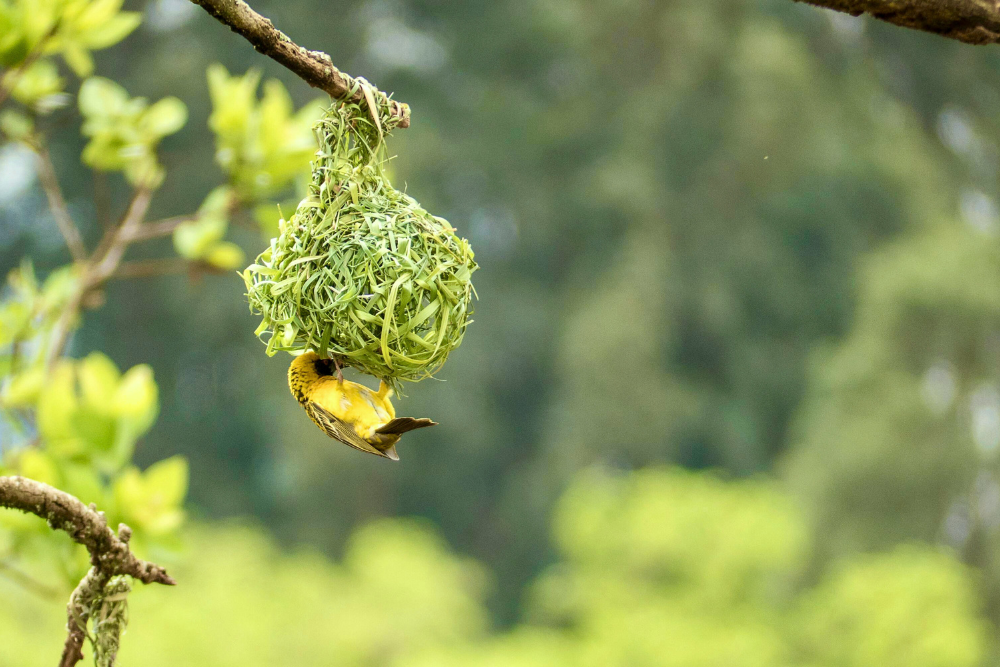
When fresh grasses grow at the start of the rainy season, breeding begins. Male weaverbirds gather long strips from the edges of rivers and fields. Over the course of building a single nest, a bird may collect hundreds, sometimes even a thousand, of these narrow strands. Holding them in his beak, he weaves and threads them around thin branches.
An attachment ring forms first, anchoring the structure. Over time, more strands are pulled through and tightened. The dense, finished nest hangs downward, with a narrow opening that faces the ground.
Soon another structure takes shape nearby. During a single season, one bird may build a dozen or more, spreading them across the branches of the same tree. Some are finished quickly, while others remain half woven. From below, the tree appears crowded with green forms clustered along its limbs.
A Careful Inspection
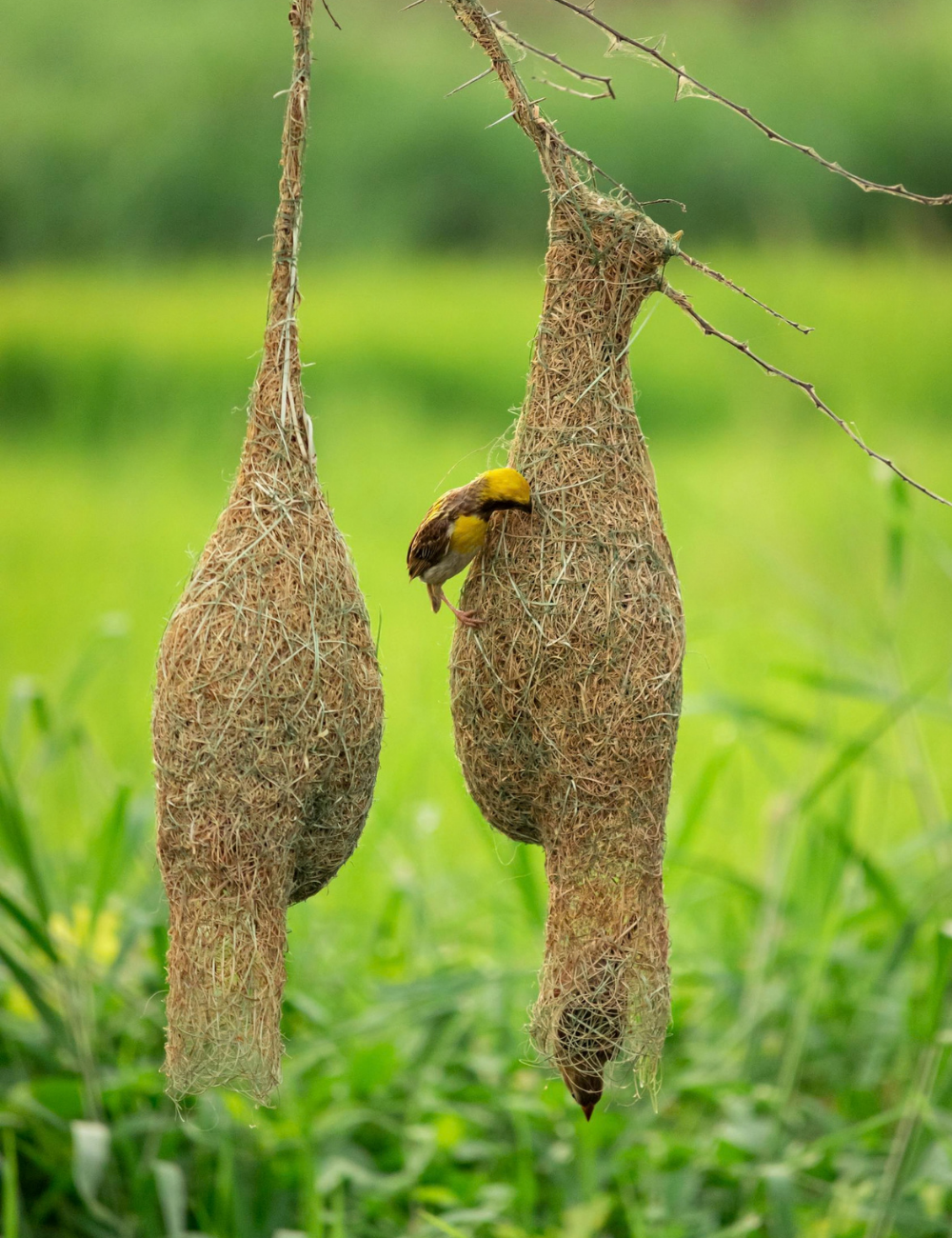
When construction is complete, the male flutters his wings to attract attention. Soon a female arrives to inspect the work. She moves from nest to nest, pausing to examine each one. With quick movements, she tugs at the woven walls and peers inside.
If a dwelling feels loose or poorly shaped, she leaves without hesitation. The male may dismantle that one, reusing any fresh materials, or he may leave it and begin another nearby.
Only a few nests are chosen for breeding. Most remain unused, dangling quietly as evidence of time spent practicing, rebuilding, and refining.
Built for the Season
The design of the nests reflects the conditions around them. Predators struggle to reach them because they hang over water or in trees that are difficult to climb. A downward-facing entrance leads to a chamber where the eggs and chicks are kept safe.
As the rains pass and the drier months begin, time and weather take their toll. The green grasses dry, grow brittle, and fade to brown. Wind gradually loosens the weaving, and many unused nests fall apart before the next breeding season arrives, leaving little trace of their careful construction.
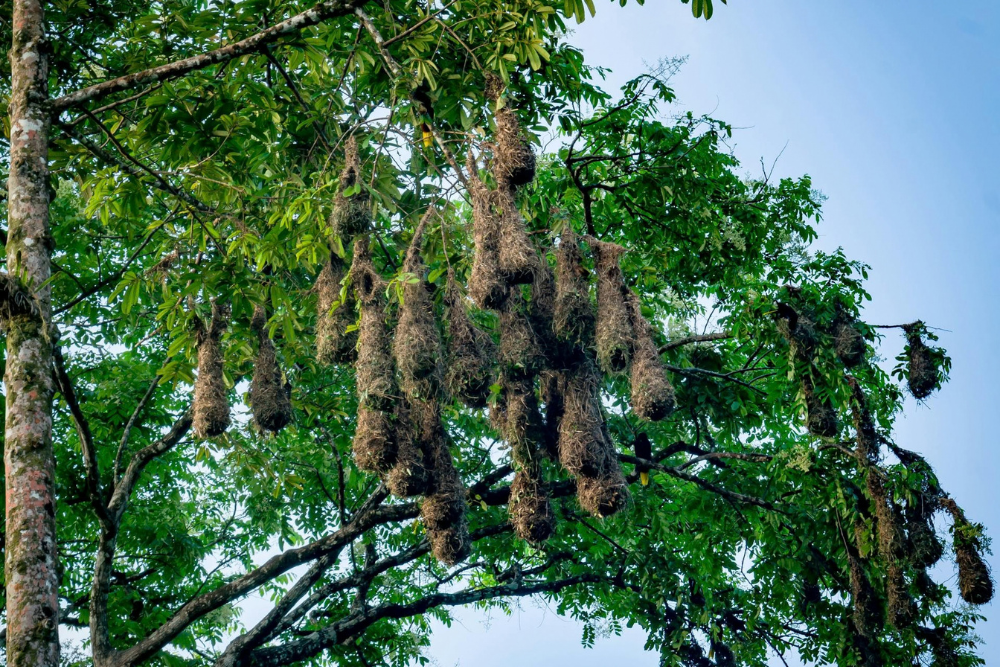
A Season’s Record
To an observer the nests may appear similar, repeating the same shape again and again. Yet each one marks hours of effort and moments of choice. A single tree can hold the record of an entire season, shaped by patience and persistence.
When the rains return and fresh grasses grow again, the weaverbirds begin building once more. Soon the branches start to fill.
Have a suggestion for this story? We’d love for you to submit it!
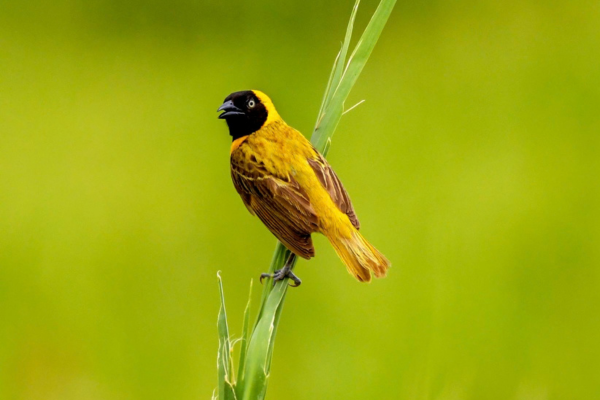
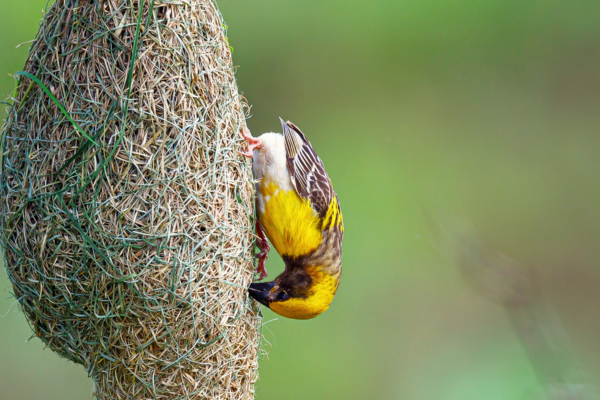
Adaptation of “A Baya Weaver Building a nest” by Hari K Patibanda. Licensed under CC BY-NC-SA 2.0.
Blank
Blank
Math Resources
Sample Problems:
- A tree has four weaverbird nests. One nest falls down. How many nests remain in the tree?
- A weaverbird collects five pieces of grass on each trip. If he makes seven trips, how many pieces of grass does he collect?
- A tree has six branches with eight nests on each branch. How many nests are in the tree altogether?
- A male weaverbird builds 24 nests during a season. If only one out of four nests is chosen by a female, how many nests are selected?
- A researcher observes that a weaverbird takes about four days to build a nest. If the bird spends 60 days building nests during the rainy season, how many nests could he complete if he builds continuously?
- A scientist studies a colony of weaverbirds and records the number of nests in three trees: 36, 42, and 54. What is the mean (average) number of nests per tree?
- A researcher estimates that 35 percent of the 240 nests in a wetland area remain intact after the dry season. How many nests remain? If the nests were evenly spread across 12 trees, what is the average number of remaining nests per tree?
Extension Questions
-
Male weaverbirds often build many nests during a single season, even though only a few are chosen by females. Each one takes time and effort to complete. Why might it be useful for a bird to offer multiple options?
-
Weaverbird nests are carefully woven and often hang from thin branches, sometimes over water or in places that are difficult for predators to reach. The shape and location of the nests help protect the eggs and chicks inside. Can you think of other examples where animals build shelters that fit the conditions around them?
Explore Further
- What a male weaverbird’s life is like
- Scientific facts about weaverbirds
- Why weaverbirds build such elaborate nests
- Video of male weaverbirds at work
Share Your Story
Write your own Global Math Story and send it to us!
 English
  Spanish
Sorry, the comment form is closed at this time.