
SRI LANKA
Fishing on Stilts
By Charlotte McGlone
Chapel Hill, NC, United States
What would you need if you were going fishing in the ocean? At the top of your list would probably be a boat, followed by a rod baited with sea animals or your lucky saltwater lure. You’d want a net, bucket, tools, binoculars, hat, sunscreen — a lengthy list!
In Sri Lanka, innovative fishermen are successful at catching fish with a simple method requiring little more than two wooden poles and a lot of patience.
About Sri Lanka
Sri Lanka is a small island off the coast of India in the Indian Ocean. It is about 25,300 square miles with a population of almost 22 million. It has been the longtime home of many different religious and ethnic communities, such as:
- the Sinhalese, the largest ethnic group
- the Indigenous Vedda people
- Tamil families with long ties to southern India
- Moors and Malays, whose histories are connected to Indian Ocean trade
- Burghers, whose ancestry includes European colonial settlers
All these different groups have their own unique customs, but perhaps one of the most interesting is stilt fishing.
How Does It Work?
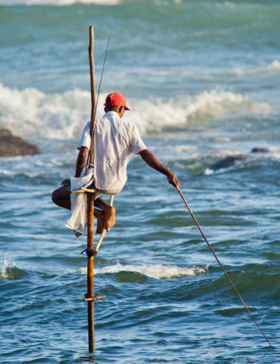
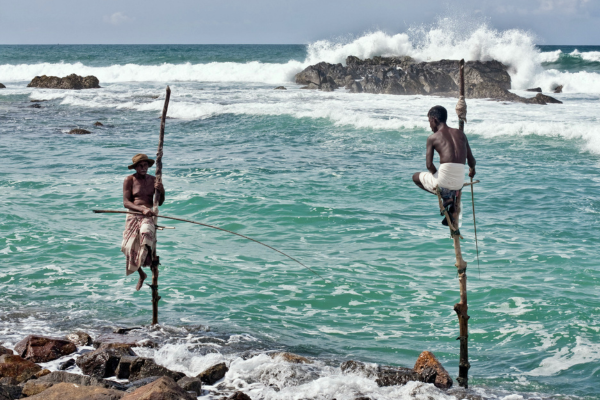
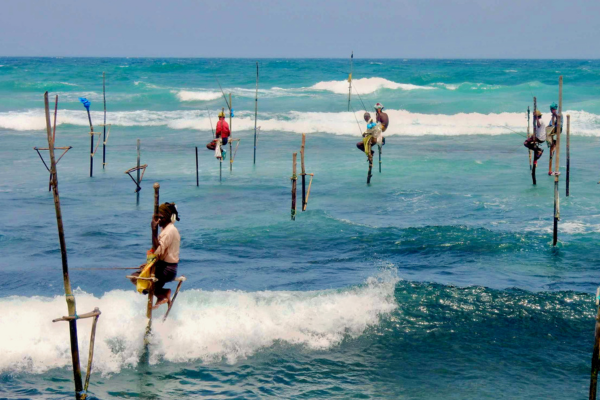
Stilt fishing is a method where a fisherman places one or two sticks deep into the sand a few meters offshore, then builds a thin bench to sit on, forming a triangle. The triangle is the best shape for this bench because it is the most stable polygon. These seats are no more than a thin piece of bamboo that may be fewer than six inches wide! Can you imagine sitting on something that skinny? It can’t be comfortable.
Next, the fisherman casts his line and waits until a fish comes along to be caught. Sometimes, he may stay out for hours! However, these fish are not barracudas. They are small coastal fish, barely even the size of a sardine and probably weighing less than one pound. Some are known locally as koramburuwo or bollan, and they swim in the shallow waters along Sri Lanka’s southern coast.
Then and Now
Nobody can say exactly when stilt fishing began, but many accounts trace it to the years around World War II, when food shortages and crowded fishing spots pushed people to try new ways to catch fish from shore. Locals say the skill was passed down through families. A father might teach his son how to climb the pole, balance above the water, and wait for the fish to come along.
For a time, some families used this method to catch food and earn money. Those with the best sticks and locations had a certain pride and status.
Nowadays, the custom is fading as a regular way to fish. It is not a lucrative business to support a family on, so many fishermen have other jobs. In some places, stilt fishing now happens more for tourists than for catching dinner. Still, this is an amazing custom that requires patience, skill, and strategy.
Have a suggestion for this story? We’d love for you to submit it!
Adaptation of “Stilt Fishermen in Sri Lanka” by Adam Brill. Licensed under CC BY-NC-SA 2.0.
Adaptation of “Fishing on Stilts, Sri Lanka” by FLASHPACKER TRAVELGUIDE. Licensed under CC BY-SA 2.0.
Blank
Blank
Slideshow
Math Resources
Learning Activities:
- Connecting to the Standards: Expressions and Equations (Grade 6)
- Fractions (Grades 4–5)
Sample Problems:
- The first fisherman catches 17 fish, the second one catches 24 fish, and the third catches 30 fish. If there are 15 people in their families, how many fish does each person get?
- If the seat on which the fisherman sits forms a right triangle, with the base four inches long and the height three inches long, using the Pythagorean theorem, determine the length of the hypotenuse. Can you find another set of integers that forms a right triangle?
- A fisherman catches three fish in the first hour, six fish in the second hour, and nine fish in the third hour. If this pattern continues, how many fish will the fisherman catch in the twelfth hour?
- If the seat is 12 inches deep and the support forms a 27 degree angle, how long will the support have to be?
- If each pole is six feet long, and the stilts are 10 feet apart, how much area would overlap between the two fisherman?
- If each of the 500 families catches x fish per hour for 12 hours a day, write an equation and solve to find the number of fish per hour they would need to catch to feed a town needing 6,000 fish?
Social Justice Questions
- Because stilt fishing is such a unique custom to witness, it draws tourists. Local men will wait on beaches and offer to pose on the poles for a price. Does this seem to you like preserving, reinventing, or exploiting a custom?
- The civil war between Tamil separatists and the Sri Lankan government ended in 2009, but peace can be hard to maintain. Recently, Sri Lanka has made efforts like giving land back to Tamil communities and changing its government leaders in 2024. Do you think these actions will help the country stay peaceful? What challenges do you think people in Sri Lanka still face, and what could be done to bring people together?
- Sri Lanka is the first Asian country known to have a female ruler, Queen Anula (47-42 BCE). Why do you think female rulers are so rare in the history of the world?
Explore Further
- Video interview about keeping the tradition alive
- One-minute video of stilt fishermen at work
- More images of the daily lives of stilt fishermen
Share Your Story
Write your own Global Math Story and send it to us!
 English
  Spanish
Sorry, the comment form is closed at this time.