
FLORIDA
When the Seagrass Disappeared
By Nicki Newton
Bridgeport, CT, United States
Inspired by the manatees
Let’s travel back in time to Florida, to a calm, clear morning in the 1970s on the Indian River Lagoon. The riverfront is bustling with activity. Fishermen and local families are traveling in small boats to town docks and bait shops.
Just below the surface are dozens of manatees swimming among the seagrass. These gentle giants glide past, coming up for air with their whiskered snouts every few minutes.
Today, that scene has become rare. A seagrass crisis has occurred.
A Vanishing Food Source
Over the years, humans have polluted the waterways, triggering algae blooms. The murky water blocked the sunlight from reaching the plants below. In some parts of the lagoon, nearly all of the seagrass disappeared, causing manatees to starve. These herbivores can grow up to 13 feet and weigh 3,500 pounds, so they eat enormous amounts of food every day. Without enough seagrass, they were dying.
The year 2021 brought staggering losses. Over 1,100 manatees died. Many survivors were dangerously thin, with rib bones visible through their thick, wrinkled skin. In 2022, hundreds more deaths occurred.

Photo “Manatee Feed” by Florida Fish and Wildlife. Licensed under CC BY-NC-ND 2.0.
Floating Salad Bar
Florida wildlife officials responded with an unusual plan. After studying the problem and weighing short- and long-term solutions, they launched a carefully controlled feeding trial. During the winter months, officials and volunteers provided thousands of pounds of leafy greens, mostly romaine lettuce. It was like a floating salad bar.
The effort helped many manatees through a dangerous time. On some days, as many as 800 gathered, bobbing and snuffling at the surface. Over two winters, they ate more than 600,000 pounds of leafy greens. That is about 300 tons, or roughly 300 to 400 pickup truck loads.
Beyond the Lettuce Launch
The lettuce launch helped, but everyone knew that solution was temporary. Long-term repair would require government involvement. In 2021, Florida pledged $8 million to restore important manatee habitats, including warm-water springs where they congregate in cold weather. The funding also supported cleaning waterways, replanting seagrass seedlings, reducing pollution, and improving water quality.
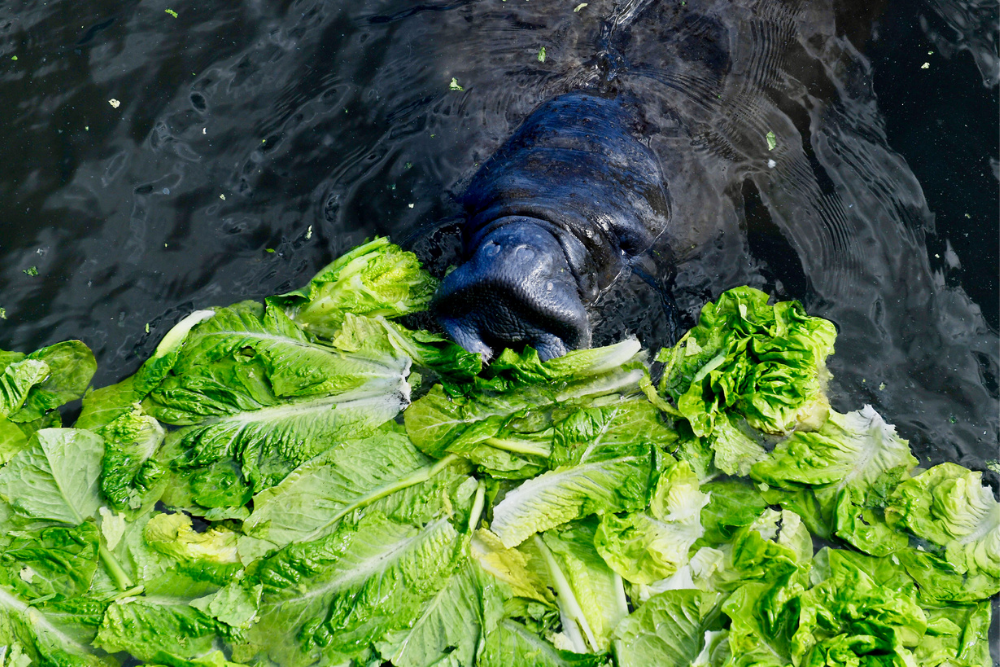
Photo “Manatee Feeding” by Florida Fish and Wildlife. Licensed under CC BY-NC-ND 2.0.
Scientists, conservation groups, and trained volunteers worked together. Some planted tiny seedlings one by one, hoping the lagoon would become healthy enough for seagrass to grow again.
Hope Below the Surface
Those efforts are beginning to show signs of progress. The manatees seem to be making a comeback, but the danger hasn’t disappeared. They still face boat strikes, cold snaps, red tides, fishing gear entanglements, and habitat loss.
If you ever visit Florida and spot a manatee gliding below the surface, take a moment and watch. Beneath that quiet movement is a bigger story about water, food, and survival.
Each patch of seagrass and clean stretch of lagoon makes a difference to these peaceful creatures. With every seedling planted, new roots take hold, and so does the hope that manatees will once again find enough to eat in the waters they call home.

Adaptation of “Sunrise over the Indian River Lagoon” by Michael Seeley. Licensed under CC BY 2.0.
Have a suggestion for this story? We’d love for you to submit it!
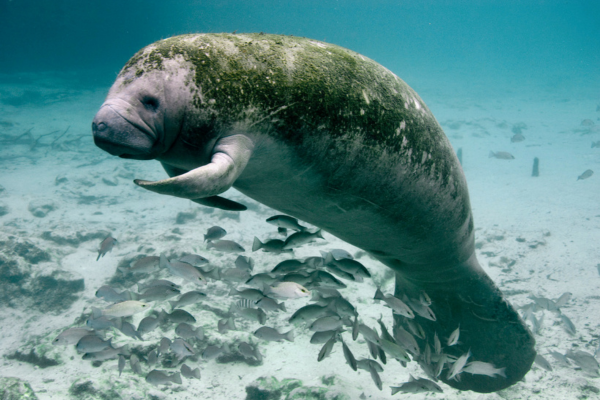
Adaptation of “Endangered Florida manatee (Trichechus manatus)” by USFWS Endangered Species. Licensed under CC BY 2.0.
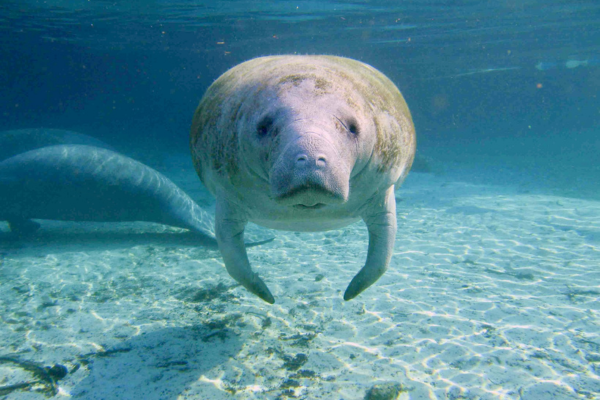
Photo “Here’s Looking at You, Kid” by U.S. Geological Survey. Public domain.
Blank
Blank
Math Resources
Sample Problems:
- Grade 1: A family sees five manatees swimming in the lagoon. A park ranger says there are 12 manatees there altogether. How many manatees are still underwater?
- Grade 2: A manatee comes up for air every five minutes. If it comes up three times in 15 minutes, how many more times will it come up in the next 10 minutes?
- Grade 3: Volunteers pack lettuce into boxes. Each box holds six heads of lettuce. If they fill eight boxes, how many heads of lettuce do they pack altogether?
- Grade 4: A rescue center uses 3,600 pounds of lettuce over 12 days. If they use the same amount each day, how many pounds do they use daily?
- Grade 5: A manatee weighs 3,500 pounds. Another weighs 2,850 pounds. What is the difference in their weights?
- Grade 6: Scientists estimate that seagrass in one area grew from 2,000 acres to 2,500 acres in one year. What percent increase does this represent?
- Grade 7: A wildlife team spends $240,000 on restoring a lagoon. They spend 35 percent on planting seagrass, 40 percent on water cleanup, and the rest on education programs. How much money is spent on education?
- Grade 8: Scientists are modeling a manatee population. The starting population is 1,200 manatees, and the population increases by 75 manatees each year. Write an equation to represent the population after x years. Then use your equation to find the population after four years.
- High School: Scientists estimate that seagrass coverage is growing exponentially at a rate of 6 percent per year. If there are currently 2,500 acres of seagrass, write an exponential equation to model the growth and predict the amount after 12 years.
Social Justice Questions
- When human choices damage an animal’s habitat, who should be responsible for helping repair the harm? Consider the role of government, local communities, scientists, businesses, and individuals. How might each group contribute in a different way?
- The lettuce feeding program helped many manatees survive, but it was only temporary. How can people balance urgent action with the slower work of solving the bigger problem? What might happen if people focus only on the emergency and not on the cause?
Explore Further
- Report on the 2020–2022 die-off
- News article from 2023 about the manatee population status
- Research study on how seagrass can recover
- News clip about the lettuce feeding efforts
Share Your Story
Write your own Global Math Story and send it to us!
 English
  Spanish
Sorry, the comment form is closed at this time.