
INDIA
Pathshala: A Journey Through an Ancient City
By Khushbu Singh
Mumbai, India
In northern India lies Varanasi, a historic city on the banks of the Ganges River. The river stretches for about 2,525 kilometers (1,569 miles), flowing from the Himalayas toward the Bay of Bengal. Many people know Varanasi by its older name, Kashi, which appears in ancient writings. In Hinduism, the Ganges is revered as a sacred river, and many believe its waters can wash away sins and help free the spirit.
Steeped in legend, Varanasi is said to be the home of Lord Shiva, the Hindu deity associated with creation and destruction. Along its waterfront, narrow stone steps called ghats descend to the river. Varanasi has 88 ghats, where residents and pilgrims gather for daily rituals, prayer, and spiritual reflection.
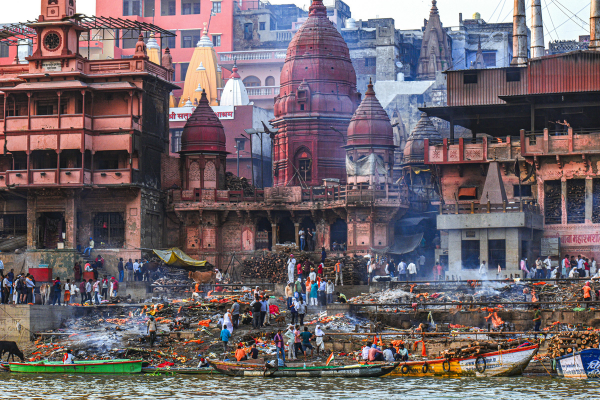
Each morning at sunrise, many of Varanasi’s ghats come alive with bathers and chanting priests. One of the most sacred sites is Manikarnika Ghat, where funeral pyres burn throughout the day. Many Hindus believe that dying in Varanasi can help the soul attain moksha, or liberation from the cycle of rebirth. Because of this belief, families from across India journey here to honor loved ones at the river’s edge.

Along the Ghats and Galis
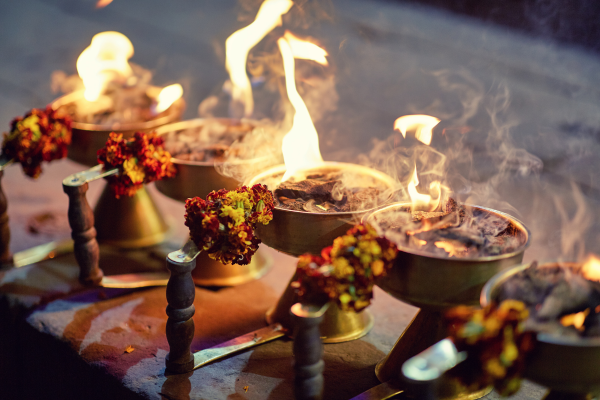
At Dashashwamedh Ghat, priests perform the evening Ganga Aarti, a ritual of light and prayer. They hold large brass lamps and move them in careful patterns while chanting Sanskrit verses. Flames shine across the water as crowds gather along the steps to watch.
Beyond the riverfront, Varanasi continues through a maze of narrow alleys known as galis. These passageways wind between temples, shops, homes, and centuries-old mansions built close together above the ghats. Some are so narrow that pedestrians, scooters, and slow-moving cows pass within inches of one another. Near the center of this network stands the Kashi Vishwanath Temple, built in 1780, among the most important of Varanasi’s many temples dedicated to Lord Shiva.
Varanasi is also famous for its textile traditions, especially Banarasi sarees. Weavers create these garments from silk and decorate them with intricate metallic thread designs. A saree is usually made from one long piece of fabric, often about 5.5 meters (6 yards) from end to end. The patterns may reflect local architecture, flowers, leaves, or other images from nature. Brides wear colorful Banarasi sarees woven with these motifs.
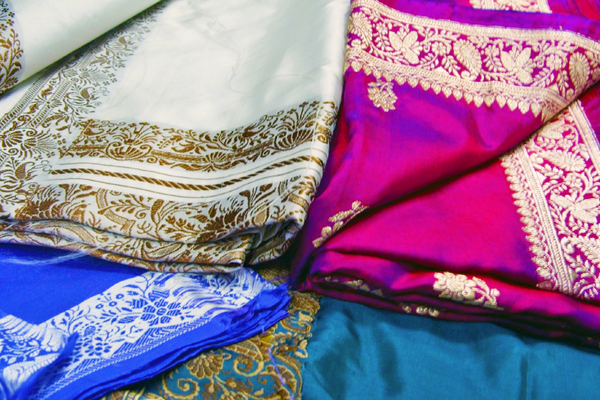
Adaptation of “Saree Mami 5” by Giobi. Licensed under CC BY-NC-SA 2.0.
A School Without Walls
On the outskirts of Varanasi is a unique school, Pathshala. It has no buildings or walls. Instead, it is made up of the open sky, fields, and trees. Each morning children from surrounding villages arrive on foot or by bicycle. Teachers use scavenger hunts, stories, and real-world observations to spark learning. For example, a small group of students might gather leaves, fruit, and stones to practice measuring and comparing.
Pathshala’s daily routine is shaped by both the weather and local expectations. During the monsoon, floods might prevent students from attending. Social pressures can also push some girls to leave school before graduation. In the face of these challenges, the students’ resilience and the commitment of their teachers help learning continue.
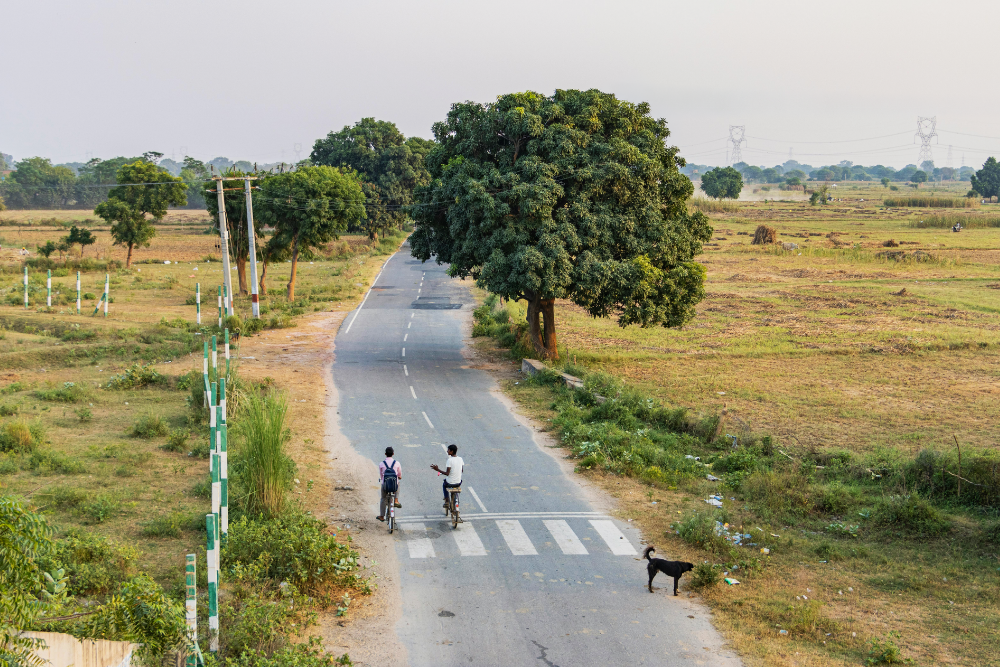
Across Varanasi, meaning is found in patterns: in temple walls, woven sarees, winding galis, and the changing flow of the Ganges. At Pathshala, students learn to notice patterns too. They count, compare, measure, and ask questions using the world around them as their classroom. In a place where tradition runs deep, the school offers a simple but powerful idea: learning can thrive anywhere, as long as children are encouraged to look closely and think deeply.
Have a suggestion for this story? We’d love for you to submit it!
Blank
Blank
Math Resources
Sample Problems:
- Grade 1: A Pathshala student collected 15 objects: some leaves and some stones. What could the collection be? Show two different answers.
- Grade 2: Varanasi has 88 ghats. Show two different ways to group 88 that make it easier to count.
- Grade 3: A Banarasi saree border has 48 flower motifs arranged in equal rows. What could the rows look like? Find more than one possible design.
- Grade 4: A Pathshala class measured the same path in steps, but students got different answers. What could explain the difference? How could they make the measurement fair?
- Grade 5: A 5.5-meter saree border uses a repeating pattern. Choose one repeat length that fits evenly along the border and one that does not. Explain what happens in each case.
- Grade 6: Pathshala attendance for five days was 36, 32, 28, 30, and 34 students. Which measure best describes the week: mean, median, or range? Explain your choice.
- Grade 7: During monsoon season, 28 of 40 Pathshala students attended school. Use proportional reasoning to decide whether you would describe the attendance as strong. Explain your answer.
- Grade 8: A saree motif is enlarged by a scale factor. The original motif is 12 centimeters long, and the new version must be between 18 centimeters and 30 centimeters long. What scale factors are possible?
- Grade 9: A student walking to Pathshala is d kilometers from school after t hours. Create a linear model that makes sense for the situation. Explain what the slope and starting value mean.
- Grade 10: A Pathshala class wants to model the circular motion of Aarti lamps. Choose a radius, then find the circumference and area of the circle. What does each measurement tell you about the motion or space?
Social Justice Questions
- People visit Varanasi for many reasons, but residents also live their daily lives there. How can visitors learn from a sacred place respectfully without treating its people or traditions like a museum display?
- Pathshala’s setting gives students chances to learn from the world around them, but creativity alone cannot replace every support students may need. What can students gain from learning in fields and under trees, and what resources do all students still deserve?
Explore Further
- Varanasi facts for kids
- An introduction to Hindu beliefs and traditions for kids
- Wildlife and conservation of the Ganges River
- The history of Banarasi sarees
Share Your Story
Write your own Global Math Story and send it to us!
 English
  Spanish
Sorry, the comment form is closed at this time.