
INDONESIA
The High Life
By Chadd McGlone
Chapel Hill, NC, United States
Imagine that you’ve embarked on an expedition to explore New Guinea, the world’s largest tropical island. The island is divided between two countries. Papua New Guinea occupies the eastern half, while the western half belongs to Indonesia.
You begin in Western New Guinea, a region covered with tropical forests and wetlands. Roads do not reach many remote communities, so people may travel by boat or follow paths.
At Home in the Trees
After hiking deep into the dense vegetation, you enter the traditional homeland of the Kombai people. Kombai families belong to clans, and each one has its own area of land. The forest provides materials for shelter as well as places to garden, hunt, fish, and gather food.
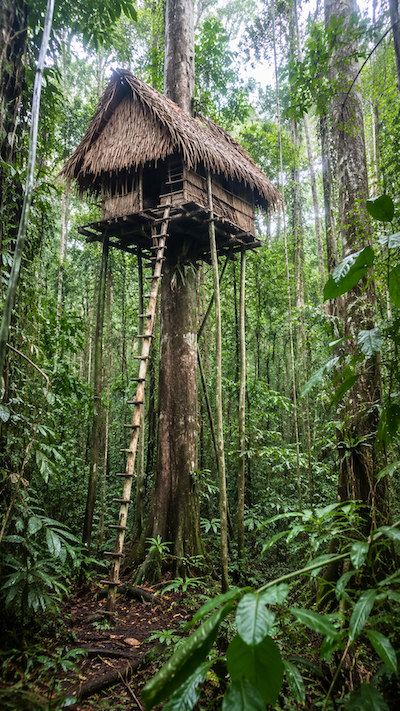
Imagine looking up and seeing someone’s house perched high above the forest floor. Traditional Kombai homes are commonly built about 5 to 15 meters (16 to 49 feet) above the ground.
Construction begins with a strong tree that can support the weight of the dwelling. Builders raise wooden poles and beams around it, carefully fitting the framework together and tying the pieces with plant fibers gathered nearby. Bark and leaves are then added to form the floor, walls, and roof, turning materials from the surrounding landscape into a sturdy shelter in the treetops.
Why So High?
Why build so high? An elevated home can provide protection from flooding, damp ground, animals, and some insects. It can also give residents a wider view of the surrounding area and make it easier to see anyone approaching.
A notched pole serves as a ladder. Climbing into the house takes balance and care, especially when carrying food or other supplies.
On the Menu
The forest also provides much of what goes into the Kombai people’s daily meals. Families grow crops and gather plants as well as hunt and fish. One of their staples is sago, a starch taken from the soft inner part of a type of palm tree.
Preparing sago requires several steps. First, the tree is cut down and its inner material is broken apart. Water is used to separate the starch from the plant fibers. The wet starch can then be cooked and eaten.
Sago grubs, which grow inside the trunks of fallen sago palms, are another customary food. These pale, wiggling larvae may not look appetizing to everyone, but they are rich in fat and protein. They can be roasted over a fire or wrapped in leaves and cooked.
Some people describe these bite-sized snacks as rich and nutty, with a soft center and a crisp outside. Would you be brave enough to try one?
Have a suggestion for this story? We’d love for you to submit it!
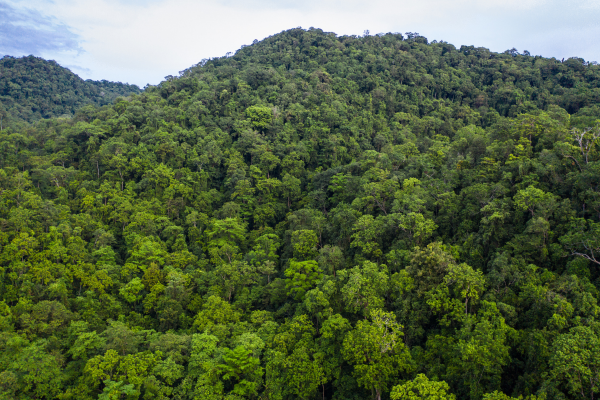

Photo “Raja Ampat Islands, Papua, Indonesia” by Globe Trotting. Licensed under CC BY-NC-ND 2.0.
Blank
Blank
Slideshow
Are you a teacher who’s interested in telling this story to your students? Here’s a slideshow you can use to get started.
Math Resources
Learning Activities:
- Counting Without Counting (Grades 3–12)
- Fractions (Grades 4–7)
- Connecting to the Standards: Expressions and Equations (Grade 7)
Sample Problems:
- Given the dimensions in the story of the average Kombai home, how much area does it cover in square feet? How about in square inches?
- Dr. Jones was a visitor to the Kombai tribe who tried to live as they do. She arrived weighing 145 pounds and spent three months with them. She lost an average of 0.25 pounds per day. How much did she weigh when she left?
- If the pole to a house has notches every 36 inches, and the house is 60 feet off the ground, how many notches will its pole have?
Social Justice Question
How do you feel about the pursuit by some Westerners to “research” the Kombai’s way of life? Do you think they are better off left alone? What about the advances in nutrition and health care that could help them live longer and healthier lives?
Explore Further
- Basic facts about Papua New Guinea
- Other tribes in Papua New Guinea
- Video showing diversity of tribes and languages
Share Your Story
Write your own Global Math Story and send it to us!
 English
  Spanish
Sorry, the comment form is closed at this time.