
KENYA
A Story From Kar Geno
By Raphine Muga
Asembo, Kenya
Kar Geno (“Center for Hope”) is located in Asembo, a community in Siaya County, which is in the western part of Kenya. The population is predominantly from the Luo ethnic group. Immigrants from other ethnic groups have also settled in this area. In the entire country of Kenya, the Luo constitute the fourth-largest group, with 2024 estimates of approximately six million.
Luo Facts
One member of the Luo people whose name will be familiar to residents of the United States is the father of former president Barack Obama. His father, Barack Obama Sr., was born in 1936 and raised in what is now Siaya County, on the shore of Lake Victoria, not far from the Uganda border.
The Luo people began migrating from what is now South Sudan, through Uganda, and into western Kenya about 500 years ago. Some historians trace their roots to the Agoro region and other Luo-speaking communities in Acholiland. Luo oral tradition tells of a leader named Ramogi who guided their ancestors into Kenya. Conflict, competition for land, drought, and food shortages may all have played a part in these migrations.
The Luo language, Dholuo, is the most widely spoken language in this part of Kenya. However, you will also hear Kiswahili, the national language, as well as English, one of the country’s official languages.
Most of the population is Christian with a small number of Muslims. Luo religious tradition includes belief in a god called Nyasaye. Worship extends to elements of nature like the mountains and lakes.
Lake Victoria
Lake Victoria, the second-largest freshwater lake in the world by surface area, borders a large part of the district. Lake Victoria’s surface area is 68,800 square kilometers, and it holds 2,750 cubic kilometers of water. By this measure, it is the second-largest freshwater lake in the world.
The lake has great potential for irrigation and fishing activities. At the southernmost end of the district lies the Uyoma Peninsula, which juts out into the lake. Farther along the lakeshore is Kisumu, one of Kenya’s largest cities and an important port.
The beauty of the Siaya district is enhanced by a few scattered elevations amongst which are the Naya Hills found in the Madiany division. The ancient Nyanzian rock formations found around Lake Victoria include some of the oldest rocks in the country. You can see exposed rocks that are thought to be at least 2.5 billion years old. These rocks understandably serve as a tourist attraction, especially the big ones lying one on top of the other, a sight that cannot go unnoticed.
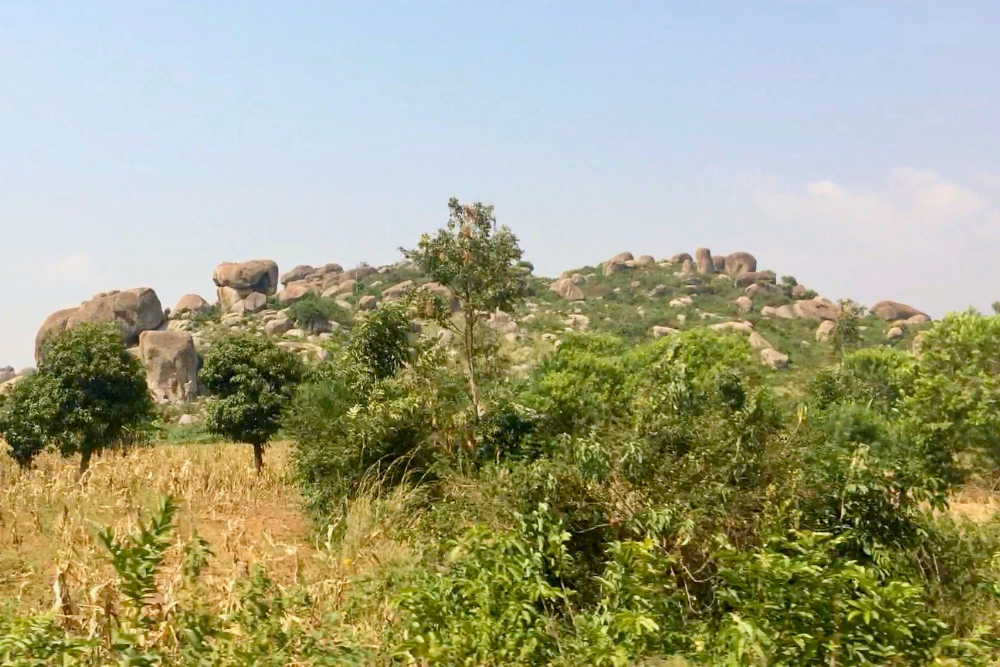
Adaptation of “A Still from Video along the Bondo-Kisian-Usenge Road” by Mark Souther. Licensed under CC BY-NC-SA 4.0.
Agriculture and Fishing
Areas at higher altitude have enough rainfall to be suitable for crop and livestock production. Lake Victoria, for example, lies 3,720 feet above sea level. The main livestock raised in Asembo are indigenous cattle breeds. They are kept as signs of wealth, for marriage payments, as well as for milk.
The recent shift in importance from cattle to crops is attributable to a number of factors. Some people have moved to urban centers in search of employment, changing who is available to care for livestock. Increase in population has necessitated the cultivation of more land, thus leaving fewer acres available for grazing.
The community also engages in subsistence agriculture as a mainstay. The main food crops include maize, sorghum, beans, cowpeas, cassava, sweet potatoes, kale, bananas, and mangoes. Finger millet is another important crop that provides more than 7 grams of protein per 100 grams. This ancient grain has been cultivated in Africa for about 5,000 years.
Fishing is the livelihood of most people living around the lakeshore. It provides a quick and easy source of income. The most prevalent species are the following:
- ngege (tilapia) — the most favored due to its delicious flavor
- omena — a smaller species, nutritious, cheap
- Nile perch — an invasive species that dominates the ecosystem and can grow to well over 100 kilograms
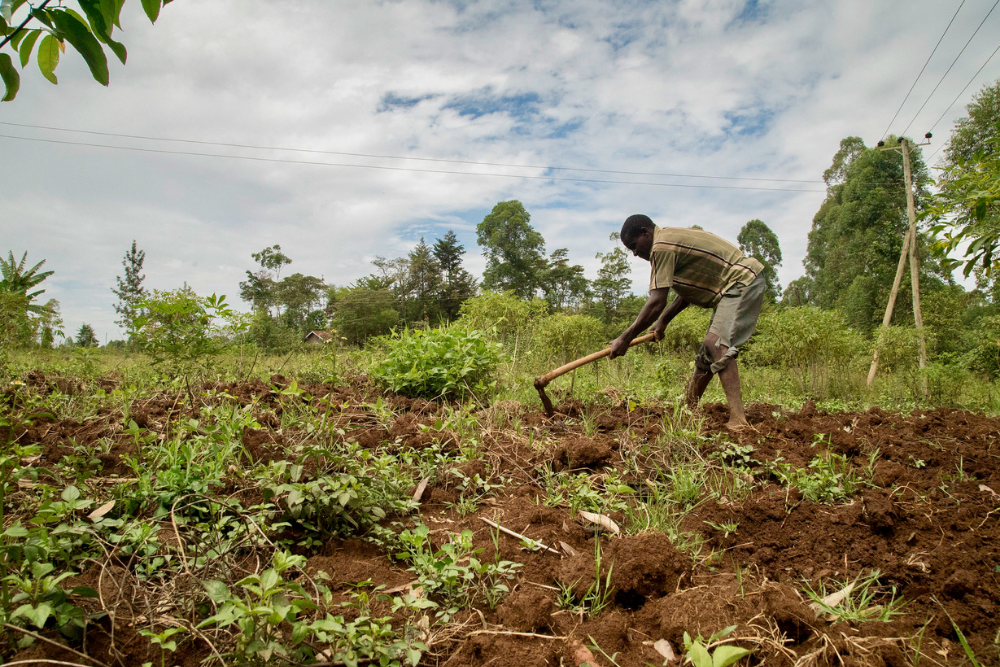
Photo “A Farmer Tills His Land” by World Bank Photo Collection. Licensed under CC BY-NC-ND 2.0.
Family Roles
In the rich culture of the Luo in Asembo, a child is raised in his or her family until a nago lak (“rite of passage”) begins the transition to adulthood. During childhood, boys and girls work to support their families, although their responsibilities vary by gender.
- Boys tend the cattle, milk the cows, and farm. They are not allowed in the kitchen because it is believed that, if they spend most of their time there, they will not be good husbands in the future.
- Girls fetch water and firewood. They also help their mothers in the kitchen with food preparation.
The father is the head of the family, and he assumes the responsibility of provider. He also guards the family against any attack.
The mother does the household chores. While women are still often expected to work in the kitchen in rural areas of Kenya, they may have somewhat greater freedom in cities.
Marriage
Marriage and raising a family are considered basic requirements for the community. After initiation, the boys and girls are considered to be grown-ups, and until they are married all boys live together in a simba (a house for bachelors). To prepare for marriage, men build homes on their father’s land with stick-and-mud walls and a thatched roof.
The marriage is organized by a jawang’ yo, an intermediary between the prospective bride and groom. After the jawang’ yo identifies the possible couple, the groom’s family makes the acquaintance of the bride’s family.
Once the families are familiar with each other, next comes a dowry-paying ceremony called a nyombo. The dowry is paid in terms of heads of cattle. One cow can be worth US$200, which is a large amount of money for rural Luo families. When the cattle cross through the gate to their new homestead, the marriage is considered completed. While the cattle belong to the bride’s parents, the house belongs to the bride.
There are several components to a Luo homestead:
- granary for storage
- cattle shed (kul)
- males-only private hut (duol) for the head of the household
- large fire pit in the center, typically built of cow dung by the head of the homestead
- one to two acres of land for growing food
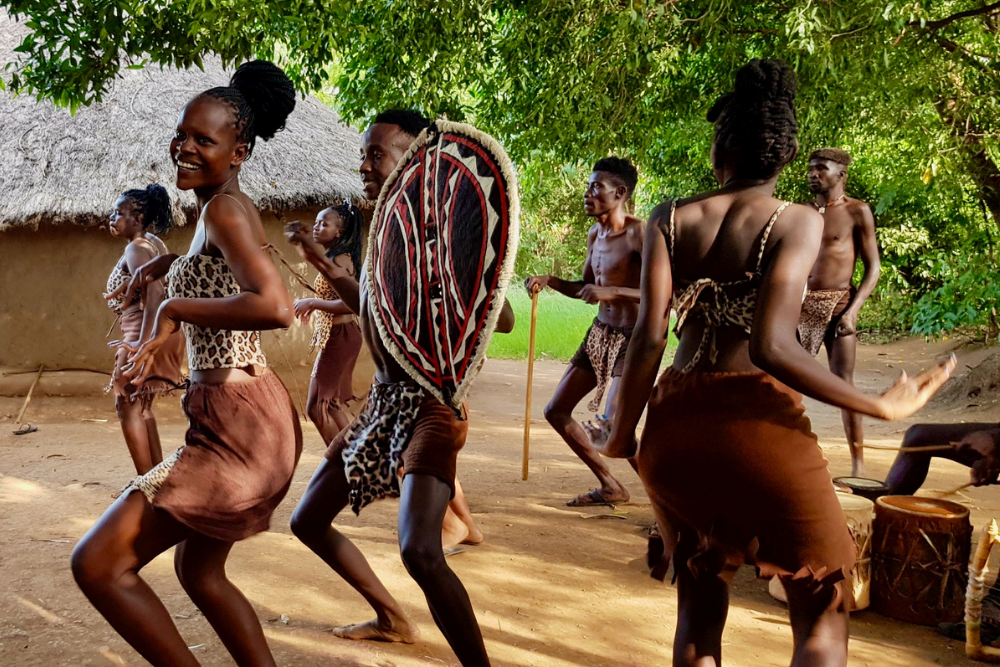
Traditional dance demonstration. Adaptation of “Dance Group, Kisumu Museum” by Victor Ochieng. Licensed under CC BY-SA 2.0.
Guests Are Welcome
If you are ever fortunate to visit a Luo community, you may find lots of entertainment. The Luo enjoy dancing since music is part of their life. You will enjoy several games accompanied by music.
You will also notice the respect and generosity accorded to the visitors. Most people from the village will want to say amosi (“hello”) and shake your hand, and children will follow you. You will be the honored guest and will be invited to share a meal of ugali (staple food made of maize flour) with either fish or traditional vegetables and porridge.
Have a change to suggest for this story? We’d love for you to submit it!
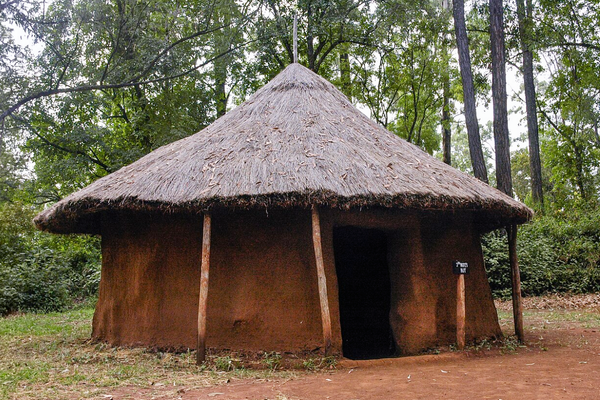
Adaptation of “Luo Village” by Alexander Leisser. Licensed under CC BY-SA 4.0.
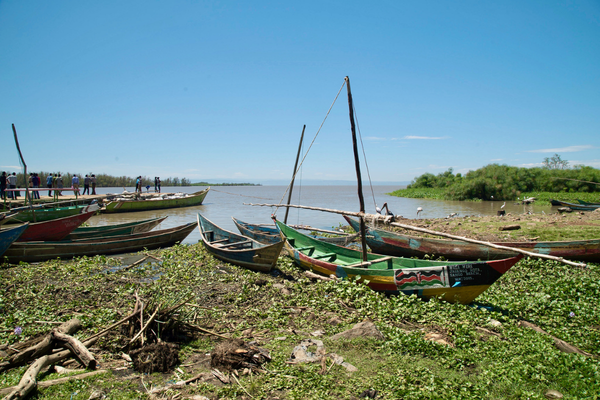
Photo “Fishing Boats on Lake Victoria” by World Bank Photo Collection. Licensed under CC BY-NC-ND 2.0.
Blank
Blank
Math Resources
- Look up the current population of Kenya. If there are approximately six million Luo, what percentage of the country does that make?
- What is the world’s largest freshwater lake, using surface area? How do you explain why Lake Victoria has the second largest surface area but ranks lower in volume?
- What do you think you would see if you could travel back in time to when the Nyanzian rocks were being formed?
- Look up information on Kenya’s unit of currency. What is the exchange rate with US dollars? Calculate how much a US$2,500 cow costs in Kenya.
Social Justice Question
Kenya gained its independence from the United Kingdom in 1964. It has since rewritten its constitution twice, in 1969 and 2010. What human rights would you place at the top of your list if you were writing a country’s constitution for the first time?
Explore Further
-
- Photo gallery for kids about Kenya
- How to say some Luo words
- Information about the Luo people
- Website for Kar Geno
- Information about fishing on Lake Victoria
Share Your Story
Write your own Global Math Story and send it to us!
 English
  Spanish
Sorry, the comment form is closed at this time.