
SAUDI ARABIA
Kites of the Desert
By Nouf Aldossary
Riyadh, Saudi Arabia
Where would you go if you invented a time travel machine? In the desert of western Saudi Arabia, you can visit the past without leaving the present. There you’ll find a collection of ancient rock structures. Known locally as “the works of old men,” these geoglyphs (large designs on the ground) serve as reminders of mysterious yesteryears.
Formed by dry-stone walls, these designs are so huge that they can be grasped only from a bird’s eye view. Although they’ve been around for millennia, it wasn’t until the 1920s that airplane pilots first brought these structures into public awareness. The recent availability of aerial photos through Google Earth has created renewed interest.
Two common motifs are a wheel and a kite. They are thought to date back as far as 9,000 years ago, to the Neolithic era. Their age makes them thousands of years older than the Nazca Lines in Peru, which were formed by the removal of stones rather than the careful placement of them.
Why Kites?
We may know how old some of these desert kite structures are, but what purpose did they serve? A popular theory is that they played a role in hunting wild game, probably gazelles and other wild animals. Because the guiding walls of the kites can be several kilometers long, gradually narrowing into smaller triangular enclosures, scholars believe that the shapes at the end of the funnels could have trapped moving herds.
Interestingly, 95 percent of the kites found farther north in Jordan narrow from southeast to northwest, which would have been the seasonal migration path for most animals. Some enclosures also had circular attachments several meters across that might have held hunters or their prey.
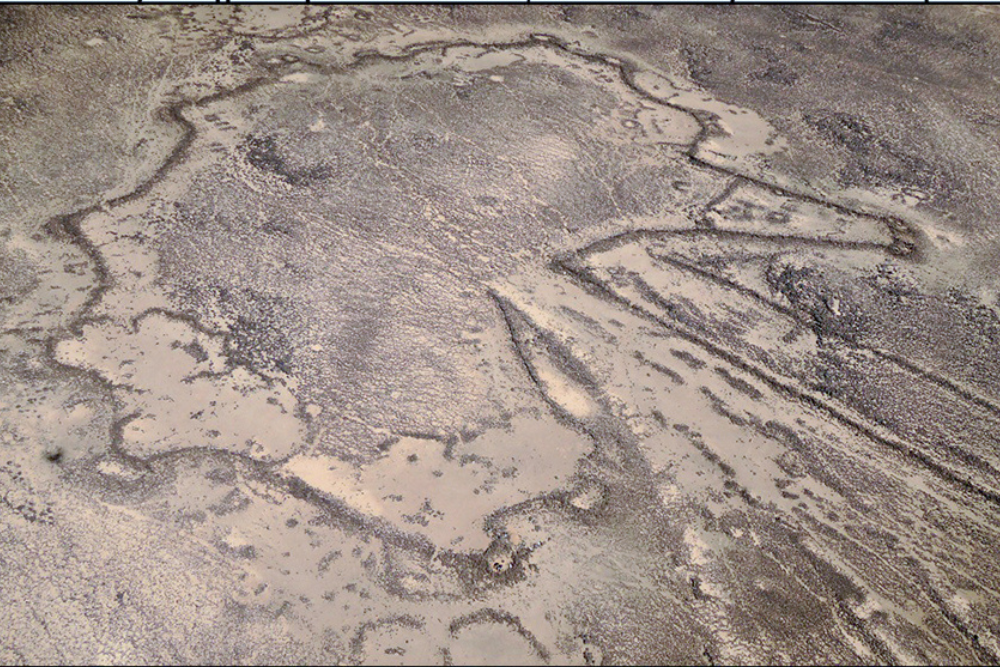
Adaptation of Fig. 1F “Distribution and characterization of desert kites” by OB, Globalkites Project, from Crassard et al., “The oldest plans to scale of humanmade mega-structures,” PLOS ONE. Licensed under CC BY 4.0.
Historic Significance
An intriguing theory about the circular structures, or cells, also highlights a turning point in human history. Rather than being simple hiding places for hunters, many of the cells may have been traps where animals were caught. If so, the kites show that ancient people were not only hunting, but also working together in organized groups.
Counting Kites
The location of these kites across the Middle East and beyond is extensive. Numbering over 6,000, they have been found from Syria and Jordan through Saudi Arabia and Yemen, and even farther north and east in places such as Armenia, Kazakhstan, and Uzbekistan. One scholar studying kites in Jordan’s Harrat al-Sham region estimated that their total wall length could be as much as 3,780 kilometers (2,349 miles). That is so much stone that it may add up to half the volume of the Great Pyramid at Giza.
In Saudi Arabia, they are concentrated in the ancient lava-field region known as Harrat Khaybar, located in the western half of the country. Although this is now an arid landscape of hardened basaltic lava, the climate was wetter at times in the past and would have supported more vegetation. Perhaps the stones formed a foundation for the insertion of poles and branches. The resulting fence could therefore have secured large animals using readily available materials.
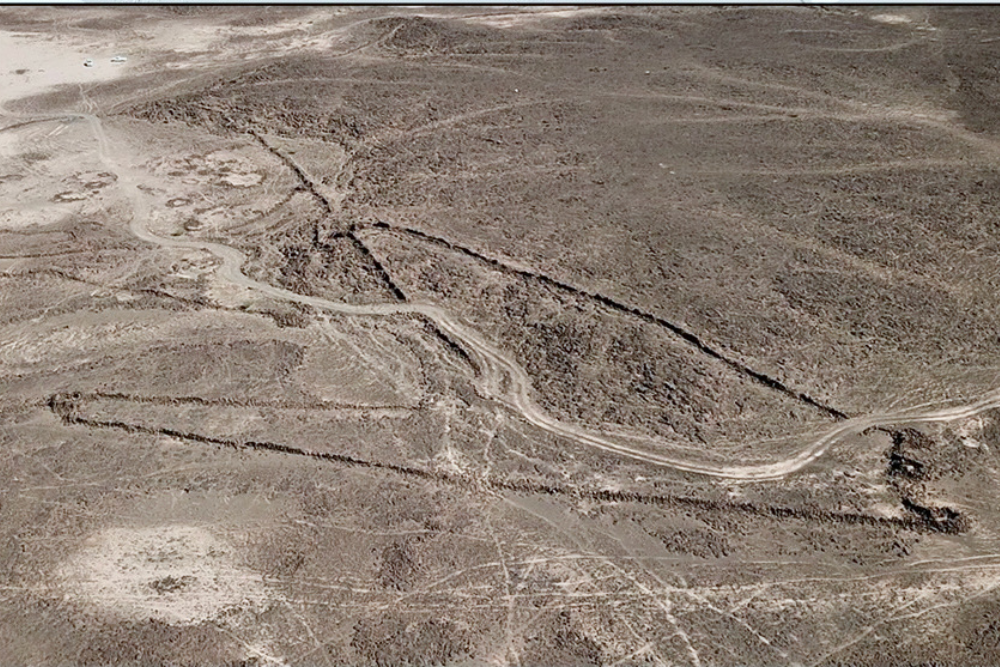
Adaptation of Fig. 1G “Distribution and characterization of desert kites” by Khaybar Longue Durée Archaeological Project, RCU-AFALULA-CNRS, from Crassard et al., “The oldest plans to scale of humanmade mega-structures,” PLOS ONE. Licensed under CC BY 4.0.
Conservation
A fear among those who study these mysterious structures is that they will disappear before we can truly understand them. For example, comparing aerial photographs of the Jordanian landscape of the 1950s with the present day reveals that agricultural development has destroyed dozens of kites. Other modern changes, such as roads, construction, mining, and expanding settlements, can also damage ancient sites. As a result, scientists are working diligently to catalog as much information as possible.
New Discovery
In 2017, this research effort drew attention to another mysterious motif in Harrat Khaybar: long rectangular structures called gates. Nearly 400 were identified, ranging from 13 meters to 518 meters long. Some may be as old as 9,000 years, but archaeologists are still working to understand when they were built and what purpose they served. Although many details can be explored through Google Earth, researchers need to examine the gates in the field to decipher their secrets fully.
Have a suggestion for this story? We’d love for you to submit it!

Adaptation of “Desert Kite2” by galpaz. Licensed under CC BY-SA 4.0.
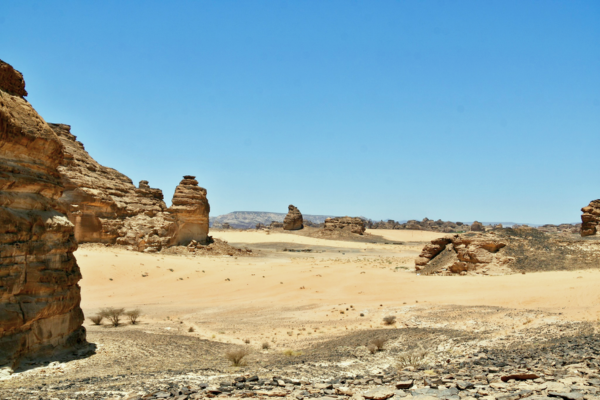
Adaptation of “Landscape at al-Ula, Saudi Arabia” by Richard Mortel. Licensed under CC BY 2.0.
Blank
Blank
Math Resources
Learning Activity:
- Geometry (High School)
Sample Problems:
- If the number of kites in Jordan is 550, calculate how many of them are not oriented along previous animal migration paths. What is the average length of the walls in a kite? (See the story for clues.)
- Which measure of center would you choose (mean, median, or mode) to answer the following question: if the rectangular gates range from 13 meters to 518 meters long, and there are 394 of them, what is the average length (assuming a normal distribution)? What would cause the average to be lower or higher than your estimate?
- If each stone measures 15 centimeters, how many would have been needed to construct an average gate? In square meters, how much area is covered?
Extension Question
The age of these structures makes them an important part of human history. Yet they are so large and numerous that housing them in a museum would be impossible. What do you think is the best way to preserve them for us all to learn from and enjoy?
Explore Further
- Blog post about the kites by an archaeologist
- Ancient Origins webpage
- NASA satellite image of the Harrat Khaybar lava fields
- News story on the gates
Share Your Story
Write your own Global Math Story and send it to us!
 English
  Spanish
Sorry, the comment form is closed at this time.