
SPAIN
El Acueducto de Segovia
By Rachel Emanuel
Quito, Ecuador
The security of a country depends on its access to fresh water. No group of humans could ever hope to thrive without a reliable source for drinking, farming, and daily life. The ancient Roman Empire was no exception.
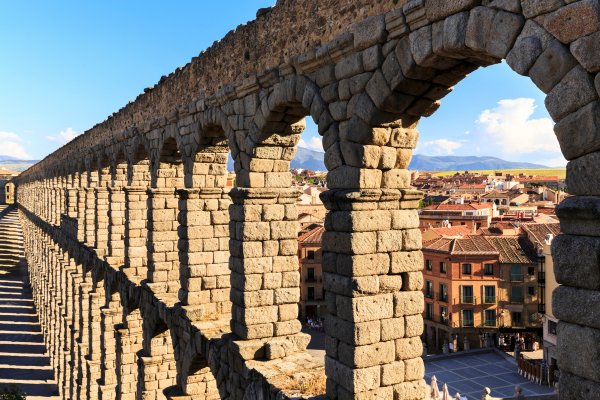
Engineers built 11 elaborate aqueducts to carry fresh water into the city of Rome. Across the lands the Romans occupied, they created similar systems to supply towns and settlements. One of the most famous and best-preserved examples is the Aqueduct of Segovia, Spain.
Construction and Engineering
No one knows the exact date of the aqueduct’s construction. The inscription that once appeared near the top has been lost over time. Many historians believe it was completed in the first or early second century CE, when this part of Spain was under Roman rule.
The magnificence of the aqueduct lies in how simply it was built. The visible part stretches more than 2,667 feet (800 meters) through the city. The original system carried water from the nearby mountains over a much longer route, probably about 15 kilometers. More than 20,000 massive granite blocks were joined together without mortar or clamps. Instead, the stones were cut and balanced so carefully that their own weight helped hold the arches in place.
The water moved by gravity, flowing gently downhill from the mountains toward Segovia. This may sound easy, but it required careful planning. If the slope was too steep, the rushing current could damage the channel. If it was too flat, the flow could come to a halt.
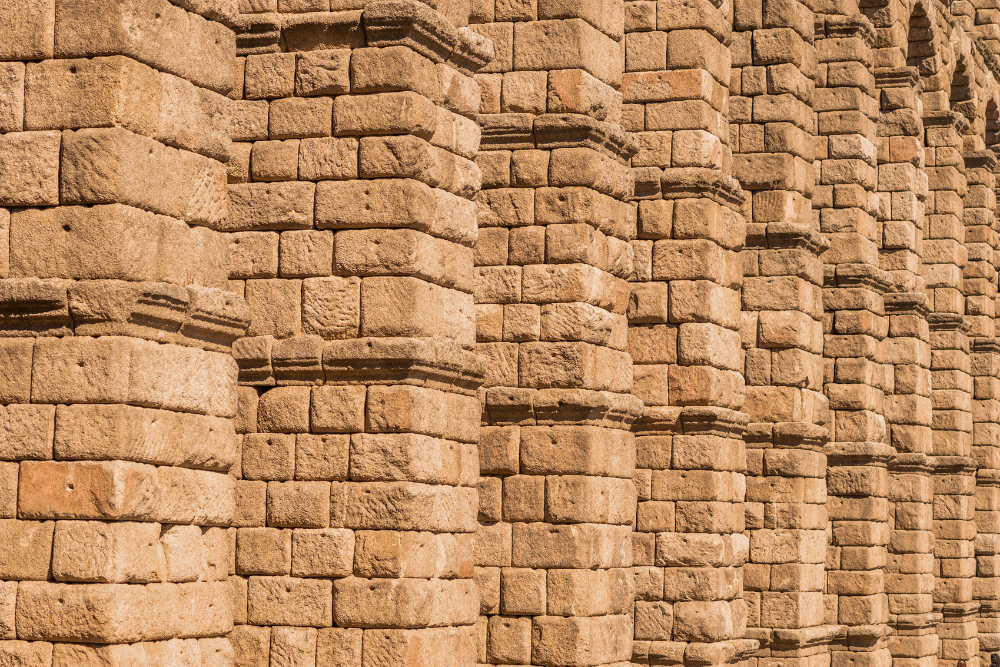
The aqueduct carried water to Segovia for centuries. Today, it is no longer used as the city’s water supply, but it remains one of its most important landmarks. Pollution, weather, leaks, and vibrations from traffic have all created conservation challenges.
Dimensions
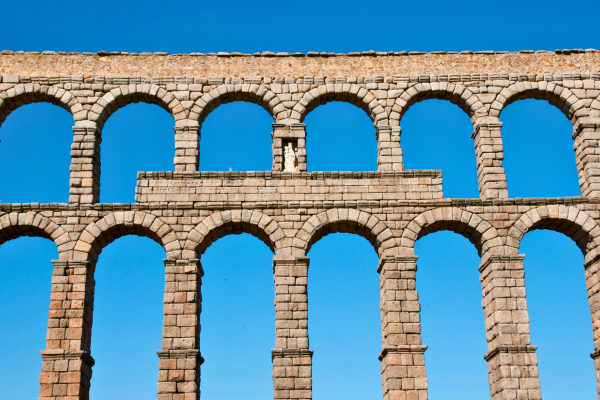
The most famous part of the aqueduct is the section that crosses the city, with its 166 arches arranged in two rows. Its height changes across this span, reaching about 93.5 feet (28.5 meters) at its tallest point. During the reign of King Ferdinand and Queen Isabella in the late 15th century, 36 arches were rebuilt in the original Roman style.
It is easy to understand why this structure is at the top of the must-see list for visitors to Segovia, and why such care is taken to preserve it. With its combination of beauty and utility, the aqueduct is a unique marvel of ancient engineering that still feels modern.
Have a suggestion for this story? We’d love for you to submit it!
Blank
Blank
Slideshow
Math Resources
Learning Activity:
- Design Your Own Aqueduct (Middle School)
Sample Problems:
- If the construction of the aqueduct required 0.5 inches of mortar between each block, how would the total length of the aqueduct be affected by the addition of the mortar?
- How many people would you need to stand on top of in order to reach the highest point of the aqueduct without a ladder?
- Research the population of the area when the aqueduct was built. How much water was needed to supply the drinking needs of these people?
- If an aqueduct runs 10 yards, how long is the aqueduct in inches?
- The entire aqueduct is composed of 166 stone arches, King Ferdinand and Queen Isabella rebuilt 36 of them. How many of the originals are left?
Social Justice Questions
- The aqueduct of Segovia shows how much effort ancient Rome put into moving clean water into a city. Why is clean water more than just a basic need, and how can access to it affect other parts of life, including health, school, work, and the future of a community?
- When political leaders choose to spend resources preserving an important historical structure, what responsibilities do they have to also consider the immediate needs of the people living around it? How might a community decide whether rebuilding 36 ancient arches is the best use of labor and money, or whether those resources should go toward other local priorities?
Explore Further
- Video scenery of Segovia’s aqueduct
- Information about the Roman Empire
- Profile of Queen Isabella of Castile
- National Geographic Resource Library page for Roman aqueducts
Share Your Story
Write your own Global Math Story and send it to us!
 English
  Spanish
Sorry, the comment form is closed at this time.