
SCOTLAND
Gothic Glasgow
By Maggie McHugh
Sparta, WI, United States
When we think about history, we often picture famous leaders, exciting battles, remarkable inventions, or the clothing people wore. These details help tell the story of the past. Another important clue to understanding history is the architecture left behind.
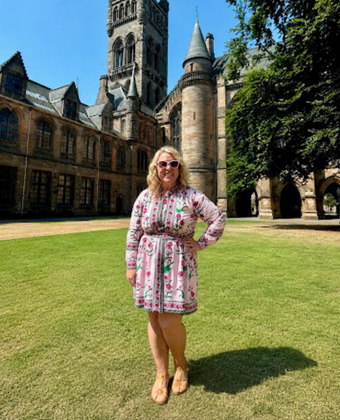
University of Glasgow
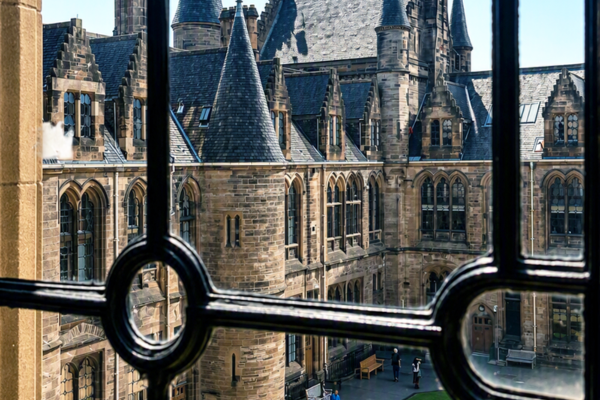
Take a stroll through Glasgow’s West End and you will encounter the University of Glasgow, established in 1451. As the second-oldest university in Scotland and the fourth-oldest in the English-speaking world, this institution boasts a campus that resembles Harry Potter’s Hogwarts. When I stepped into the quad, I imagined taking off on a broomstick chasing the Golden Snitch in a game of Quidditch.
The architects who designed it in the late 19th century embraced the grandeur and beauty of the Gothic Revival style. Towering spires rise above castle-like turrets, while circular stone staircases seem to invite visitors to explore what lies around the next corner.
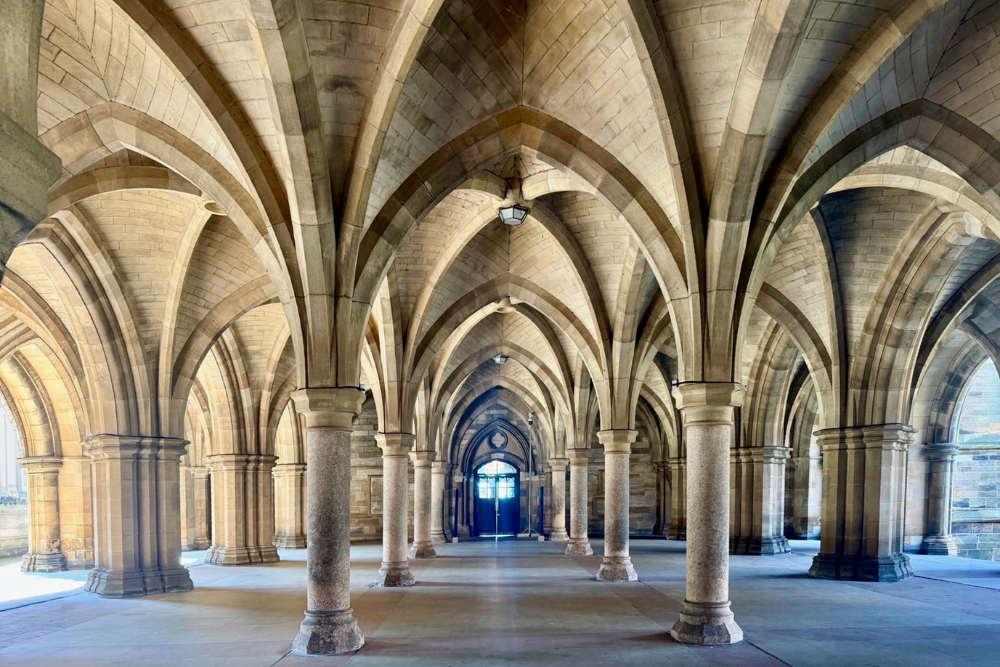
Iconic cloisters, with their sweeping stone arches, fluted columns, and transverse ribbed vaults, connect the two main quadrangles and create the feeling of stepping into another time. Walking through them, I felt transported back in time, visioning myself part of a vibrant campus community carrying books to my next class in the Midwifery Tower.
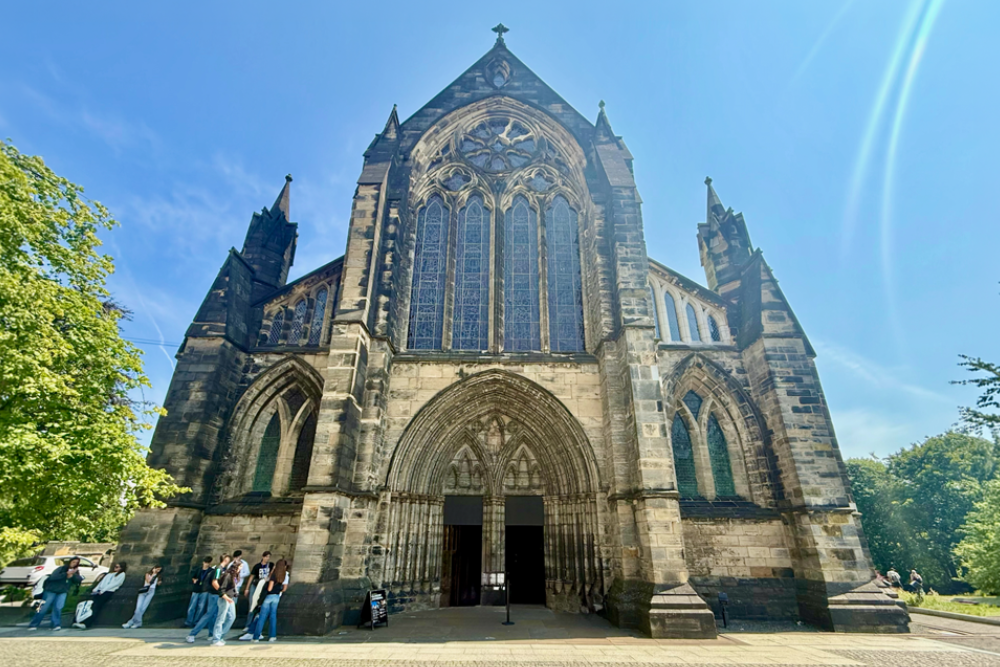
Glasgow Cathedral
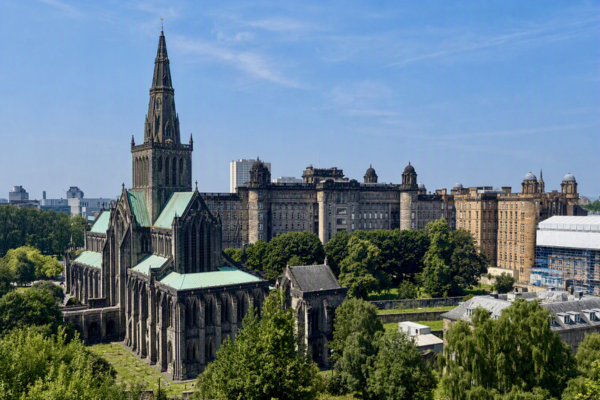
Across town, Glasgow Cathedral offers a striking example of Gothic architecture from the medieval era. Unlike earlier Romanesque churches, which had thick walls and small windows, Gothic buildings used innovations such as ribbed vaults and flying buttresses to support the weight of the stone. These advances allowed for taller, thinner walls and larger stained-glass windows.
As I approached Glasgow Cathedral from the street, I noticed a soaring central spire reaching toward the sky. Inside, pointed arches, lofty ceilings, and colorful windows draw the eye upward, creating a sense of awe and reflecting the importance of faith. Standing inside the building, it is easy to understand why Gothic architecture has endured for centuries as one of the most breathtaking styles in Europe.
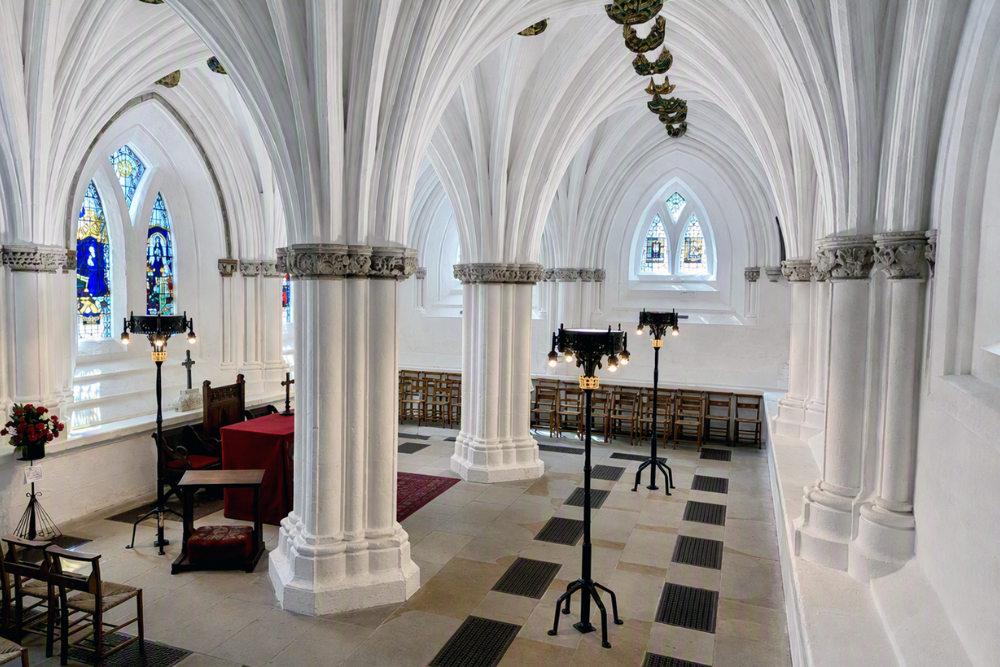
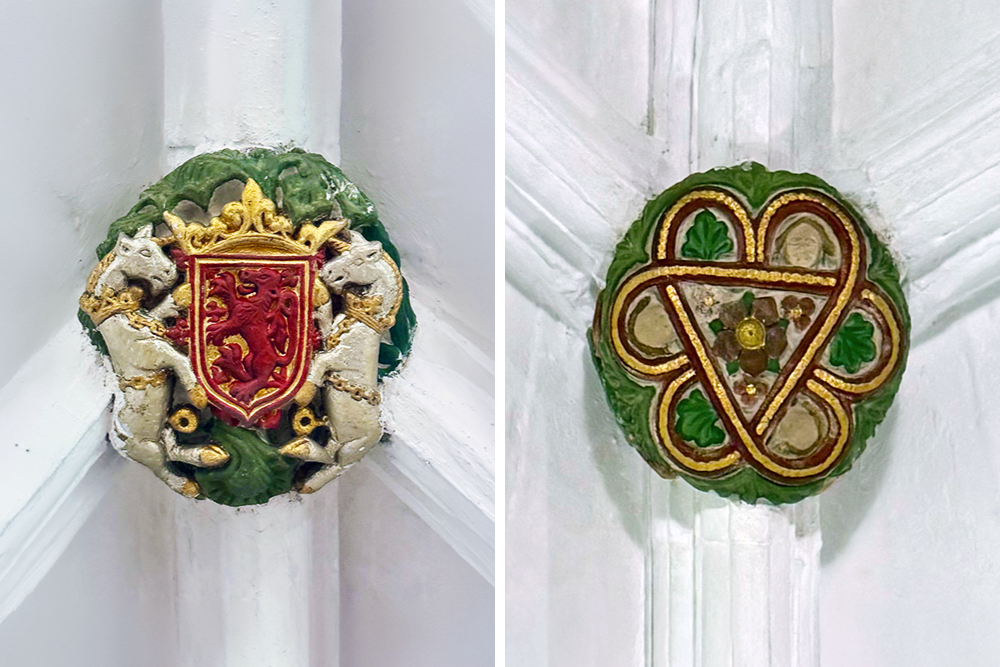
In the crypt of Glasgow Cathedral lies a small chapel named the Blacader Aisle, after Archbishop Robert Blacader added a vaulted ceiling around 1500. Looking up, you can see ornate, hand-carved decorations called bosses. Vibrantly painted, they depict coats of arms, faces, flowers, dragons, unicorns, and other mythical creatures. Wandering the crypt, my friends and I spent several minutes gazing at the ceiling, excitedly whispering “Come check this out” whenever a colorful design captivated us.
Celtic Knots
One of the ceiling bosses that featured an intricate Celtic knot immediately grabbed my attention, as my ancestors were Celtic. The Celtic peoples were groups who lived across ancient Europe and shared related languages as well as some cultural and artistic traditions. Over time, their culture became deeply rooted in Scotland, Ireland, and Wales, where their influence can still be seen today.
Celtic knots are designs made from continuous, interwoven lines with no visible beginning or end. Today they are often interpreted as symbolizing eternity, unity, and the interconnectedness of life. The boss that especially caught my eye in the cathedral features three interlaced hearts that, when traced with a finger, form one endless path.
Looking Closely at the Past
Glasgow’s architecture makes the past visible. Its cathedral showcases innovations that allowed medieval builders to create a greater sense of height. Its university shows how architects, centuries later, adapted those Gothic features for a new purpose. Peering closely at these spaces reveals how builders used stone and structure to express the ideas of their time. When we slow down and truly look at the buildings around us, we discover that history is all around us…waiting to be explored.
Have a suggestion for this story? We’d love for you to submit it!
All photos courtesy of Maggie McHugh. Used with permission.
Blank
Blank
Math Resources
Sample Problems:
- Kindergarten: A visitor notices five tall spires on one part of the University of Glasgow. They see three more spires on another building. How many spires do they see altogether? Draw a picture to show your thinking.
- Grade 1: Nine people visited the cathedral. They split into two groups. How many people might be in each group? How do you know?
- Grade 2: A student measures parts of a cathedral. A door is 8 feet (ft.), a window is 6 ft., a statue is 15 ft., and a decorative wooden screen is 12 ft. Create a bar graph showing these measurements. Which feature is the tallest?
- Grade 3: The spire on top of Glasgow Cathedral is 220 ft. tall. The bell tower at the University of Glasgow is 278 ft. How much taller is the bell tower than the spire?
- Upper elementary: Use play dough to make a long rope. Can you recreate the Celtic heart knot? Can you recreate other Celtic knots?
- Grade 4: Glasgow Cathedral is about 285 ft., or 87 meters (m), long and 65 ft. (20 m) wide. Imagine its shape is a rectangle. What are the area and perimeter?
- Grade 5: After damage from a fire, the cathedral was repaired and reopened in 1197. The University of Glasgow moved into its main building in 1870. How many years has each structure witnessed history? Write each age as a decimal representing centuries. Compare the two numbers.
- Grade 6: A stone block used in the construction of Glasgow Cathedral measures 2 m long, 1.5 m wide, and 0.5 m high. What is the volume of the stone block?
- Grade 7: The University of Glasgow has circular stone staircases. The radius of one staircase is 6 ft. To get from one floor to the next, you follow the staircase through a full 360° around its center. If the Midwifery Tower staircase takes you from the fifth floor down to the basement, what is the area of the circular staircase? How many degrees do you rotate while walking from the fifth floor to the basement?
- Grade 8: Celtic knots often use repeated patterns. An artist rotates a knot design 90°, 180°, and 270°. Describe what happens to the design after each rotation. How many degrees have the hearts been rotated in the ceiling boss? How do you know?
- High school: Look at the triquetra Celtic knot below. The circle within the knot has a diameter of 3 m. What is the circumference of the circle? Use string to trace the remaining loops. How much do you need?

Social Justice Question
The University of Glasgow has a long history of helping students who could not afford the full cost of an education. As early as 1563, Mary, Queen of Scots provided money to help five children study there. Over the centuries, churches, merchants, and other donors continued to support students through scholarships and other financial aid. What responsibility do you think universities have to make sure money does not prevent students from continuing their education?
Explore Further
- How to find the city’s Gothic locations
- Comparison of old and new Glasgow
- History of Glasgow Cathedral
- Introduction to Gothic architecture
Share Your Story
Write your own Global Math Story and send it to us!
 English
  Spanish
Sorry, the comment form is closed at this time.