
RHODE ISLAND
Where’s the Cheese?
By Chadd McGlone
Chapel Hill, NC, United States
Travel around the United States, and you’ll notice that pizza changes. New York has its big, thin slices that you can fold in half. Chicago is famous for deep-dish pizza. Detroit has thick, rectangular pizzas with crispy cheese baked around the edges, originally cooked in steel trays used to hold parts in automobile factories. Rhode Island has something a little different.
I discovered it one fall evening after a professional meeting in Providence. Everyone had gathered for snacks, and I was starving. When my host, Gina, told me there was pizza, I was delighted.
Then she handed me a rectangular strip of thick bread topped edge to edge with a layer of tomato sauce. I looked at it. There was no pepperoni. No stretchy layer of melted cheese. It wasn’t even warm.
“This is the pizza?”
“That’s a pizza strip,” Gina said. “Try it.”
The bread was chewy, with a little crunch at the edge. The sauce was thick and rich with tomatoes and herbs. I took another bite. I must say, it was among the best pizza I had ever eaten. But I had questions.
Gina explained that pizza strips come from Rhode Island’s Italian-American bakery tradition. Bakers spread bread dough into large rectangular pans and cover it with seasoned tomato sauce. After baking, they let it cool and cut it into strips. The bread is similar to focaccia, and the sauce gets far more attention than it would beneath a thick blanket of mozzarella.
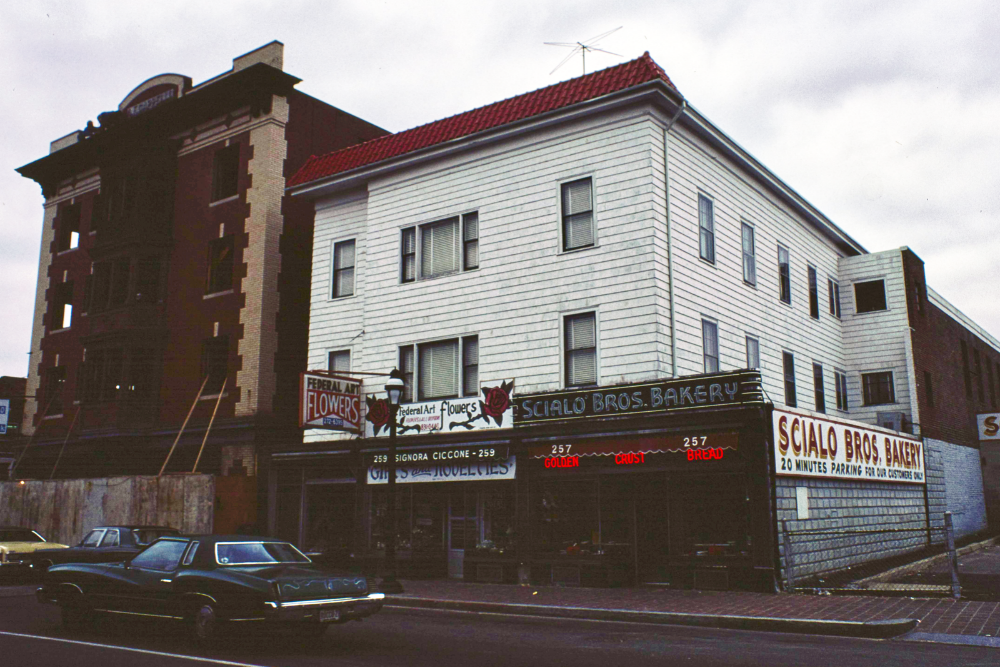
Adaptation of “Weekday Morning in the Italian District, Federal Hill, Providence, Rhode Island, 1979” by Michael Edward Bell. Public domain.
“So you don’t heat it up?” I asked.
“No,” Gina said. “Pizza strips are served at room temperature.”
That suited me. I was already halfway through mine.
“But why leave off the cheese?”
“Well, there’s a story behind the missing cheese,” Gina said.
In the early 1900s, local bakeries used leftover bread dough to make pizzas and left them on the counter for customers to buy. According to the story passed down in Rhode Island bakeries, health inspectors objected to cheese sitting out without refrigeration. Rather than refrigerate the pizza, some bakers simply stopped adding the cheese.
“So they kept the pizza and lost the cheese,” I said.
“And you don’t seem to be missing it.”
I wasn’t.
“Where would I go to get more?”
“Start with an Italian bakery,” Gina said. “Ask for pizza strips. You might also hear them called bakery pizza or party pizza.”
I wondered whether I could order a pizza strip with toppings.
“Could I get pepperoni on one?”
“Not on these.”
“Mushrooms?”
“No.”
“Sausage?”
She shook her head.
“What about mozzarella?”
“Just bread and sauce,” she said. “Maybe a very small amount of grated Romano or Parmesan. That’s a traditional red strip.”
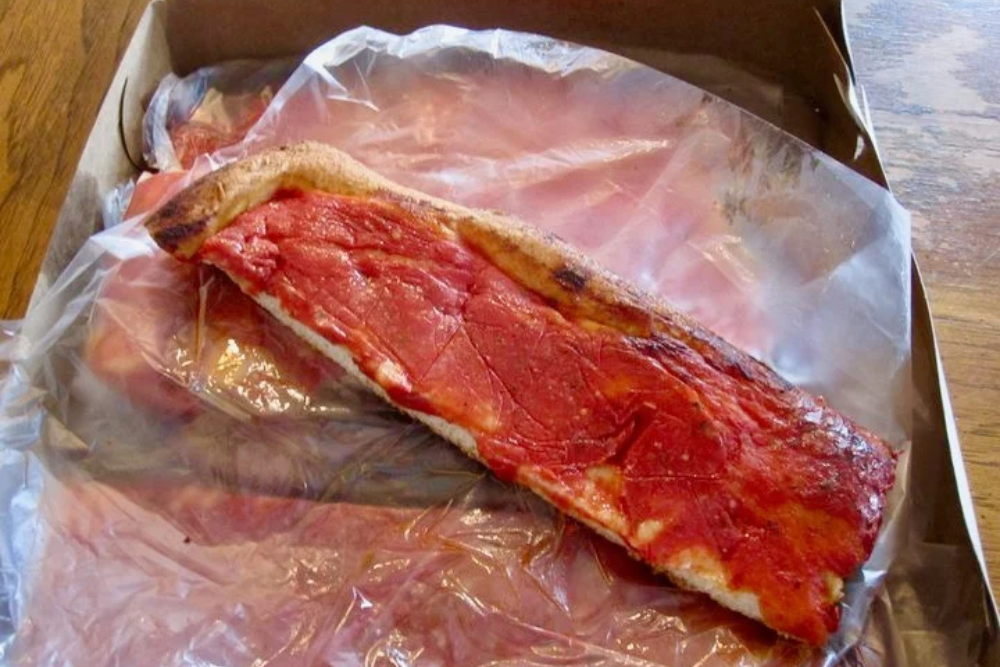
Adaptation of “Box o’ Strips” by David Iannotti. Licensed under CC BY-SA 3.0.
Rhode Islanders eat plenty of other kinds of pizza, with melted cheese and all sorts of toppings. Pizza strips are something different. You buy them from local bakeries, carry them home in boxes, and eat them at room temperature. They show up at birthday parties, ball games, meetings, beach trips, and family gatherings. In Rhode Island, a box of pizza strips can be as ordinary as a pitcher of sweet tea in the South.
Around us, people kept talking and helping themselves to the food. I grabbed another strip before they were gone.
Before leaving Rhode Island for the drive home, I stopped at a local bakery. Inside were those now-familiar red rectangles, ready to go.
“One pizza strip for the road,” I said. “Hold the pepperoni.”
Have a suggestion for this story? We’d love for you to submit it!
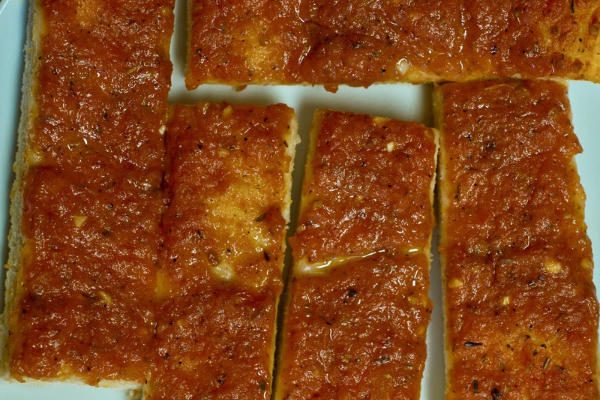
Adaptation of “Rhode Island Party Pizza” by Mark Bonica. Licensed under CC BY 2.0.
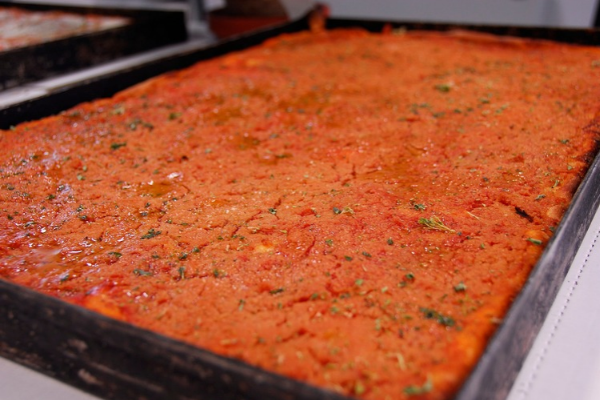
Adaptation of “Sfincione palermitano” by Rino Porrovecchio. Licensed under CC BY-SA 2.0.
Blank
Blank
Math Resources
Sample Problems:
- Kindergarten: Suppose Gina puts seven pizza strips on one plate and five on another. Which plate has more pizza strips? How could you show that you are right?
- Grade 1: A rectangular pizza strip is going to be shared equally among four people. How could you cut it so everyone gets the same amount? Could the four pieces have different shapes and still be equal shares?
- Grade 2: Suppose a baker marks a rectangular pan into four rows of five equal pieces. How many pieces will there be? How can you determine the number without counting every piece one at a time?
- Grade 3: A pan of pizza is cut into eight strips of equal area. What fraction of the whole pan is one strip? What fraction is three strips? Why does “equal area” matter?
- Grade 4: After a large gathering, five pans each have three-fourths of their pizza remaining. How much pizza is left altogether, measured in pans? Show why your multiplication represents the situation.
- Grade 5: A bakery has three-fourths of a pan of pizza left. Gina takes two-thirds of what remains for another meeting. What fraction of a whole pan does she take? Represent your reasoning with both a diagram and an equation.
- Grade 6: Suppose a bakery’s sauce recipe uses three cups of sauce for every two pans. One baker says that is 1.5 cups per pan. Another says it is two-thirds of a pan per cup. Are both rates correct? Which rate would be more useful for deciding how much sauce is needed for 15 pans?
- Grade 7: At a meeting, 15 pizza strips are eaten during the first 20 minutes. If you model the number eaten as proportional to time, how long would it take for 48 strips to be eaten? What assumption does your model make, and how reasonable is it?
- Grade 8: At 6:00 PM there are 48 pizza strips on the table. At 6:20 there are 33. Suppose they continue disappearing at a constant rate. Write a function for the number of strips remaining t minutes after 6:00. What do the rate of change and initial value mean? When does your model stop making sense?
- Grades 9–12: You are ordering pizza strips for a meeting. Between 70 and 90 people are expected, people may eat anywhere from 1 to 3 strips each, and strips are sold in boxes of 24. Build a model and recommend how many boxes to order. State the assumptions that matter most, and explain what new information could change your recommendation.
Extension Questions
- If pizza strips look very different from what most people expect pizza to be, who gets to decide what counts as “real” pizza?
- Pizza strips are ordinary to many Rhode Islanders but surprising to outsiders. What foods or customs in your community might seem unusual to someone visiting for the first time?
- If a traditional food becomes popular somewhere new, is it important to preserve the original recipe, or is adapting it part of how food traditions evolve?
Explore Further
- Why Rhode Islanders love pizza strips, plus a recipe
- Who has the best pizza strips
- History and traditions of pizza strips
- How to bake your own pizza strips
Share Your Story
Write your own Global Math Story and send it to us!
 English
 Spanish
Sorry, the comment form is closed at this time.